Flash flooding and thunderstorms bring widespread disruption across Scotland
Severe weather on Tuesday caused road closures, rail cancellations and power cuts from the Central Belt to the northeast as Police Scotland warned drivers to avoid non-essential journeys.
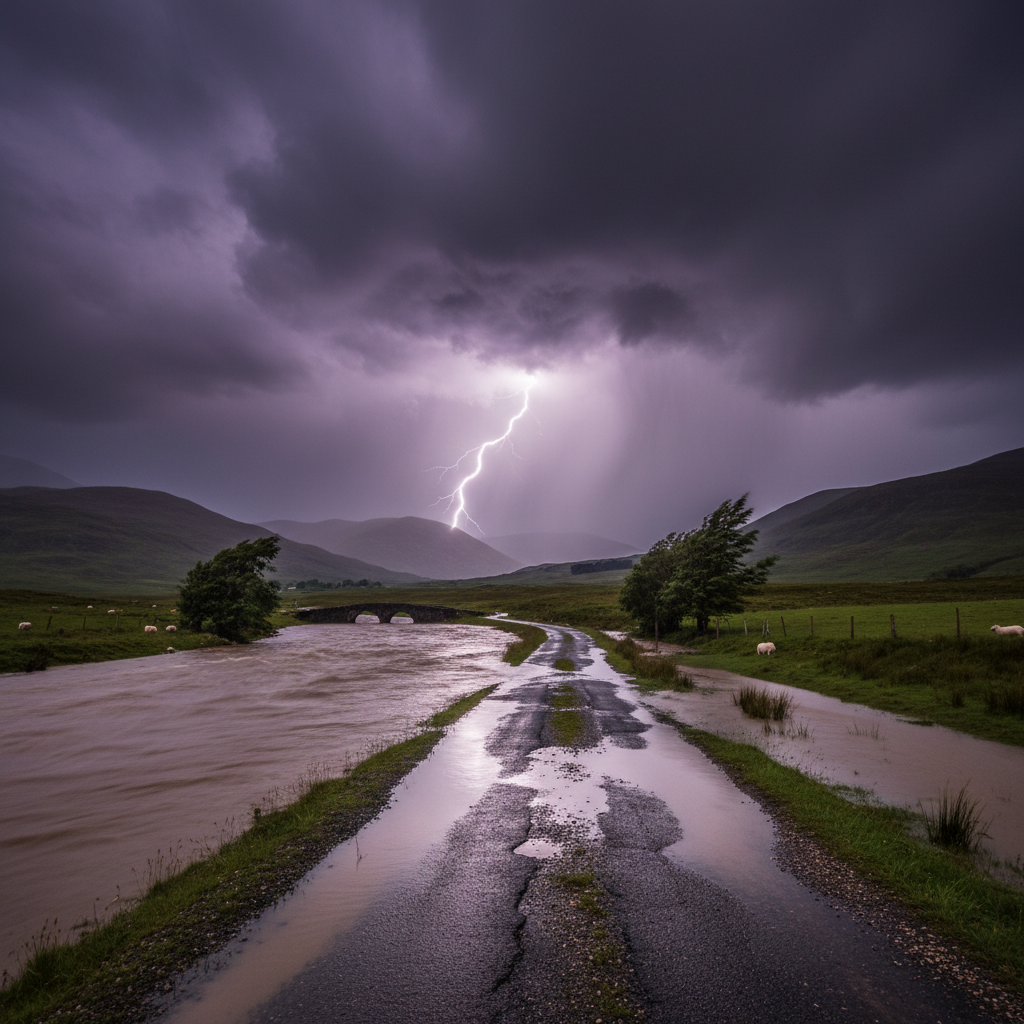
Severe thunderstorms and torrential rainfall brought flash flooding across Scotland on Tuesday, forcing road closures and rail cancellations while leaving thousands of homes without power as emergency services responded to weather-related incidents from the Central Belt to the northeast.
Police Scotland reported surface water flooding on key routes throughout the day, with officers warning drivers to avoid non-essential travel after multiple vehicles became stranded in deep water. Local councils coordinated emergency responses as the intense rainfall overwhelmed drainage systems in urban areas, particularly affecting major transport corridors.
Transport networks face widespread delays
ScotRail services experienced significant disruption with delays and cancellations across the network due to flooded tracks and signalling problems caused by the severe weather. The West Highland Line suspended operations between Glasgow and Mallaig for several hours, while services between Edinburgh and Perth faced delays of up to 90 minutes as water levels rose on approach routes.
Both Edinburgh and Glasgow airports reported minor operational disruption as the weather fronts moved across central Scotland, though flights continued with adjusted schedules. Ground handling operations at both airports experienced temporary delays, with baggage handling affected by the intense rainfall and lightning activity.
The transport chaos highlighted the vulnerability of Scotland's infrastructure to sudden weather events, with commuters facing lengthy delays during the evening rush hour as services struggled to return to normal operations. Bus operators across the Central Belt reported multiple route diversions, particularly affecting services through Glasgow city centre where several underpasses became temporarily impassable.
Power cuts affect thousands of households
Lightning strikes and falling branches damaged local electricity networks, causing short-term power outages for approximately 15,000 homes across the affected regions. Scottish Power engineers worked through the night to restore supplies, with most customers reconnected by Wednesday morning despite challenging conditions for repair crews navigating flooded access roads.
The power disruption particularly affected rural communities in Aberdeenshire and Angus, where overhead lines proved more susceptible to storm damage than urban underground networks. Several villages experienced outages lasting more than eight hours, prompting emergency welfare checks on vulnerable residents by local authorities.
Network operators reported that the concentrated nature of the lightning activity created multiple simultaneous faults, stretching repair resources across a wide geographical area. Emergency generators were deployed to maintain power supplies to critical infrastructure including hospitals and care facilities.
Met Office warnings precede intense weather band
The disruption followed a Met Office yellow weather warning for thunderstorms covering much of Scotland, with forecasters tracking a narrow but intense band of storms that moved northward on Tuesday and Wednesday. The warning system allowed some preparation, though the localised intensity of rainfall caught many areas off guard with precipitation rates exceeding 30mm per hour in the worst-affected locations.
Weather experts noted the concentrated nature of the storm system, which delivered exceptional rainfall amounts over short periods rather than the more typical sustained precipitation patterns. The storms developed rapidly over the North Sea before tracking inland, intensifying as they encountered warmer air masses over the Scottish mainland.
Meteorologists recorded wind gusts of up to 60mph accompanying the thunderstorms, contributing to the widespread tree damage and power line failures. According to the BBC Scotland report, the storms represented part of an increasingly volatile summer weather pattern affecting much of the UK, with similar systems expected to develop through the remainder of the week.
Emergency services coordinate multi-agency response
Scottish Fire and Rescue Service deployed water rescue teams to assist motorists trapped by rising flood waters, with crews responding to more than 200 weather-related incidents across the country. The service activated its emergency coordination protocols, positioning additional resources in anticipated flood-risk areas based on Met Office forecasting.
Mountain rescue teams were placed on standby as concerns grew for hillwalkers caught in the severe conditions, though no major incidents were reported in highland areas. Coastguard helicopter crews assisted with reconnaissance flights to assess flood damage in remote locations where ground access became impossible.
Communities adapt to changing weather patterns
The latest severe weather event underscores growing concerns about infrastructure resilience as Scottish communities face more frequent extreme weather episodes. Local authorities are reviewing flood defence systems and drainage capacity, with several councils announcing accelerated investment programmes for storm water management following repeated flooding incidents this summer.
Transport Scotland confirmed that climate adaptation measures for the rail network are under active review, including enhanced drainage systems and improved weather monitoring capabilities. The agency acknowledged that current infrastructure standards may require updating to cope with increasingly intense rainfall events.
The swift response from emergency services demonstrated improved coordination since previous major weather events, though the scale of simultaneous incidents across multiple regions stretched resources. As climate patterns continue evolving, Scottish communities are increasingly adapting daily routines around weather warnings and developing greater awareness of flood risks in previously unaffected areas, with local resilience groups reporting increased membership following recent extreme weather episodes.