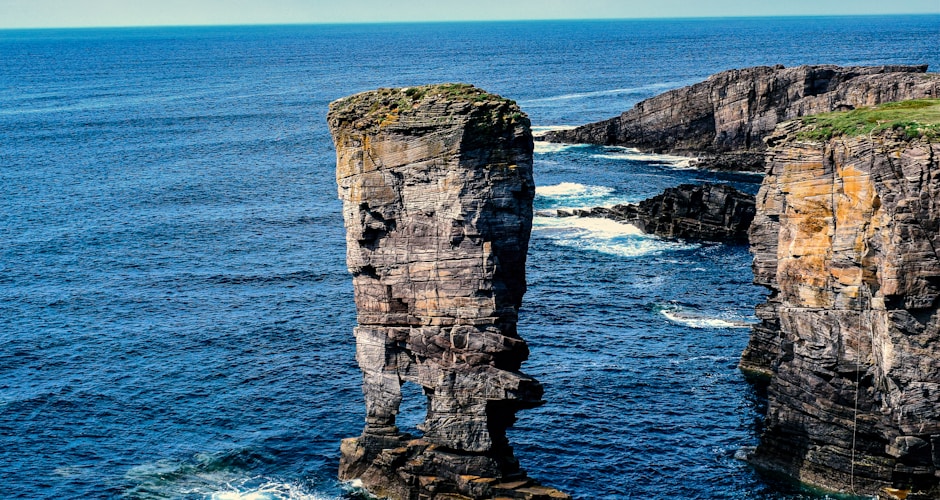
The water between the Orkney mainland and the island of Hoy moves with a violence that is hard to appreciate until you see it up close. The Pentland Firth, the strait separating Orkney from Caithness, is one of the most powerful tidal channels in the world. Water surges through it at speeds that can exceed five metres per second, driven by the Atlantic and the North Sea pushing against each other twice a day, every day, without fail. For centuries, this was simply a hazard for sailors. Now it is starting to look like Scotland’s most dependable energy source.
The European Marine Energy Centre, known as EMEC, has been operating out of Orkney since 2003. Based in Stromness, it provides purpose-built test sites for wave and tidal energy devices. The tidal test site at the Fall of Warness, off the island of Eday, sits in waters with some of the fastest tidal flows in Europe. Companies from across the world come here to prove their technology works in real ocean conditions, not in a laboratory tank.
I visited EMEC’s facilities last spring, and what struck me was the contrast between the scale of the ambition and the modesty of the operation. Stromness is a small town. The EMEC offices are not flashy. But the work being done there is globally significant. Over 30 marine energy devices have been tested at EMEC’s sites, more than at any other facility in the world. This is where the tidal energy industry is being built, prototype by prototype.
The most advanced tidal turbine currently deployed in Orkney waters is the Orbital O2. Launched in 2021, it is a floating tidal turbine that sits on the surface, with two rotors hanging beneath the hull into the tidal stream. It generates two megawatts of power, enough for around 2,000 homes. The company behind it, Orbital Marine Power, is based in Edinburgh but does its testing in Orkney. I watched footage of the O2 being towed out to its berth, and it is an impressive piece of engineering: 74 metres long, built to survive the North Atlantic, generating power from a resource that is entirely predictable.
That predictability is the key advantage. Unlike wind, which fluctuates, and solar, which disappears in a Scottish winter, tidal energy follows a pattern set by gravitational physics. You can predict the tides years in advance, to the minute. For grid operators trying to balance supply and demand, this is enormously valuable. Baseload renewable energy is the holy grail, and tidal power is closer to it than almost anything else.
Orkney itself has become something of a living laboratory for renewable energy. The islands already generate more electricity from renewables (primarily wind) than they consume. The surplus has driven innovative projects in hydrogen production, with EMEC running an electrolyser that splits water using renewable electricity to produce green hydrogen. This hydrogen has been used to fuel a local ferry and to heat buildings. Orkney is not just testing marine energy; it is building the infrastructure for a post-carbon economy in real time.
The challenge, as with most emerging energy technologies, is cost. Tidal energy is currently more expensive per megawatt hour than offshore wind. The devices are complex, the marine environment is harsh, and the industry has not yet achieved the scale needed to bring costs down. Advocates argue that tidal energy is roughly where offshore wind was fifteen years ago, before sustained investment and deployment drove costs down dramatically. They have a point. Offshore wind was once dismissed as impractical and expensive. Now it is a cornerstone of the UK’s energy strategy.
The Scottish Government has shown some commitment through ring-fenced contracts for difference, guaranteed prices that give developers confidence to invest. But the funding levels remain modest compared to wind and solar. SAE Renewables, Simec Atlantis Energy, and other developers have pushed forward, but several promising projects have stalled or scaled back due to financing difficulties. The MeyGen project in the Pentland Firth, once billed as the world’s largest tidal array, has been slower to expand than originally planned.
What Orkney demonstrates is that the technology works. The turbines generate power. The resource is there, vast and reliable. The question is whether the political and financial commitment will match the physical opportunity. I left Stromness feeling cautiously optimistic. The engineers I spoke to were pragmatic, not starry eyed. They know the obstacles. But they also know that twice a day, every day, the sea moves through the Pentland Firth with enough force to power cities. Ignoring that resource would be a failure of imagination that Scotland cannot afford.