
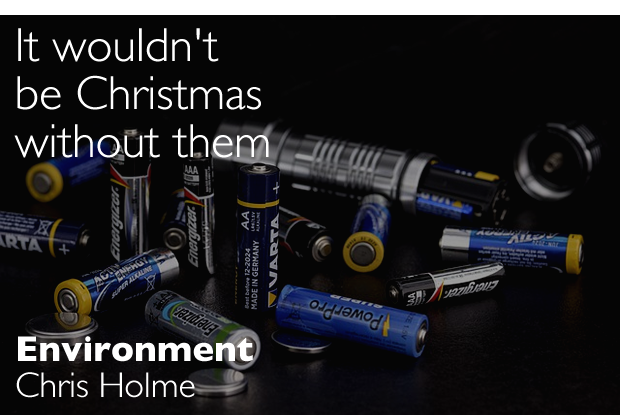
Christmas simply wouldn’t be Christmas without them. They light up our homes and bring so much joy to everyone. The trouble is that, within a few weeks or months, the vast majority are simply discarded â unloved and unwanted.
There will no restraint in the coming weeks. Forget all that worthy climate emergency baloney in Glasgow â we’ll all be in the festive stampede to stock up on batteries. The vast majority will be single use. That’s what the toy shops and supermarkets market aggressively so that’s what we end up buying. You really need to look hard for any rechargeables on the shelves â if they are there at all.
A few, even as many as 5%, might get recycled to recover the cadmium, nickel, lithium, and other precious metals. Assuming one was bought per head of population, that means nearly six million will end up as landfill for future generations to worry about.
This is an area ripe for puns and meaningless cliches so we may as well get them out of the way: It shouldn’t be a highly charged or polarised debate. The real disconnect is between politicians, retailers and young people who are tired of being spoon-fed self-congratulatory guff about ‘targets’ or ‘tackling’ climate change as though it’s a casual game of footie.
Young people aren’t stupid â they can spot the obvious. If politicians say they have several top priorities, they don’t have any priority. Step changes, moving forward and working in partnership with stakeholders just doesn’t wash any more. That’s because the impact of climate change on the planet is about to be terminal.
If there’s one practical step, we can all take now, it’s buying a charger. If shops don’t have them, ask the manager why not. I did at my local Tesco and was met with puzzled bemusement.
We have some things on our side. Young people in Scotland are the first generation to grow up without the pall of tobacco constantly over them because of a bold decision in 2006 by the Ciggy Stardust generation to denormalise smoking. Some progress has also been made in alcohol.
Scotland is small enough to take a lead and set an example. It has a reasonable pedigree in electrical engineering such as the telephone (Bell) and TV (Baird).
In medical engineering, its record is unrivalled. The world’s first X-ray service was launched in Glasgow, 1896, just months after Wilhelm Röntgen wrote to Lord Kelvin from Würzburg seeking his support. Kelvin handed it over to John Mcintyre, a former sparkie who had served his engineering apprenticeship before taking up surgery.
It was a chance phone call from Tom Brown, a young engineer, with obstetrician Ian Donald which started the development of medical ultrasound in the 1950s. Ordinary folk can also effect changes â one Glasgow woman fortuitously held off going to the toilet for fear of losing her place in the out-patient queue. When she was examined, her full bladder revealed a foetus and that was the start of obstetric ultrasound.
Scotland’s record in battery technology is less impressive but there is scope to develop this. The same applies to government, local authorities and retailers.
Shops sell them because there is more profit in single use. Some councils are collecting used batteries but it is all a bit piecemeal and pointless because it fails to address the real problem. Rechargeable should be the easy, normal choice, not throwaways. Meanwhile, the waste continues to stockpile.
First, we all need to grasp the meaning of the word emergency. Reliable and readable public information on batteries is woefully inadequate.
Apart from the environmental savings, what extra cash does buying a charger yield? Are devices like baby alarms best left to single use batteries? Why are the dangers of small button batteries not more widely known? Youngsters mistaking them for sweeties have died after swallowing them. Even when fully spent, they can easily burn through the oesophagus.
Governments can move quickly and decisively. It was known that there would be colossal demand for free hearing aids with the start of the NHS in 1948. A search was made of the best private models, then a factory was built to mass produce them. Medresco hearing aids, later unfairly mocked in Carry On films, took their name from the Medical Research Council which carried out the research and testing. More recently, the Scottish Government has also shown initiative with the distribution of baby boxes to new parents. Free battery chargers could also be distributed to those on the lowest incomes.
This needs action and, like smoking, a public health focus. A successful start here may trigger other worthwhile initiatives. We’ve already gone through this with LEDs replacing filament lightbulbs (deliberately made not to last to maximise manufacturing profit margins), to car batteries and USB chargers for phones and hairdryers.
Now is the time to look at the AAAs and AAs that power our gadgets and toys. ‘Ever Ready batteries â for longer life’ was a good advertising slogan. ‘Rechargeable batteries for longer planet life’ should be the next. Before we go into terminal decline.
