
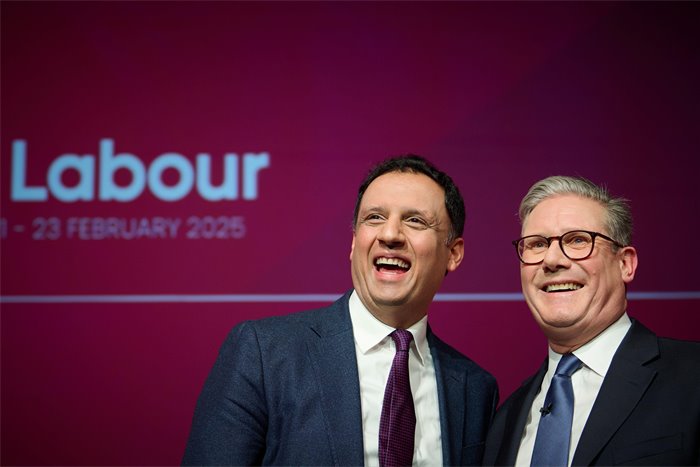
I watched Anas Sarwar stand at that podium in Glasgow on the ninth of February and thought two things, almost simultaneously. The first: this is the bravest thing a Scottish Labour leader has done in twenty years. The second: this is going to go badly wrong.
Both turned out to be true.
Sarwar’s demand that Keir Starmer resign over the Peter Mandelson affair was, on its surface, principled. The revelations about Mandelson’s relationship with Jeffrey Epstein had left a stain on Downing Street that no amount of media management could scrub away. Sarwar knew that stain would bleed northward, onto every Labour leaflet posted through every letterbox in every constituency between now and the seventh of May. He made a calculation. Better to distance Scottish Labour now than to drown with the ship later.
But politics is not about being right. It is about timing. And the timing here was catastrophic.
The Split Nobody Needed
Within hours of Sarwar’s press conference, the fracture lines appeared. David Lammy and Rachel Reeves lined up behind Starmer, as you would expect. More damaging were the murmurs from within Scottish Labour itself. Not every MSP was consulted. Not every branch was briefed. Some learned about their leader’s position the same way the rest of us did, from the television.
Starmer’s response was defiant and, I must say, effective. His line about not being prepared to “walk away from my mandate and my responsibility to my country, or to plunge us into chaos as others have done” was clearly rehearsed, but it landed. It positioned him as the adult in the room and Sarwar as the one causing the very distraction he claimed to be fighting.
John Swinney, who has made a career out of keeping a straight face while watching his opponents self-destruct, called the whole episode “opportunism.” Russell Findlay labelled it a “meltdown.” They were both being generous. What it actually was, and I say this as someone who wants competent opposition at Holyrood, was a gift. A beautifully wrapped, ribbon-tied gift to the SNP, delivered just twelve weeks before Scotland goes to the polls.
The Holyrood Arithmetic
Let me be blunt about where things stand. The January YouGov polling had the SNP on 34% of the constituency vote. That is down 14 points from 2021, which should be cause for celebration in Labour circles. Reform UK, that peculiar English import, sat in second place. Labour were competitive but not commanding.
The SNP were vulnerable. Genuinely vulnerable. After years of internal turmoil, the Sturgeon departure, the Yousaf experiment, the quiet steadying hand of Swinney, they looked beatable. Not because Scotland had suddenly fallen in love with Labour again, but because the independence question had lost its urgency and voters were ready to talk about the things that actually affect their daily lives. The state of the NHS in Lothian. The crisis in Scottish education. The fact that you cannot get a dentist in half the towns north of Perth.
That was the ground Labour needed to fight on. Instead, Sarwar moved the conversation to Westminster. To Mandelson. To Epstein. To a leadership struggle that most people in Dundee or Inverness or East Kilbride could not care less about. He made the Holyrood election about London, which is precisely what the SNP has been trying to do for thirty years.
What I Hear on the Ground
I spent a morning last week in a cafe on Byres Road in the West End of Glasgow, the kind of place where you can get a flat white and a political argument before eleven o’clock. The mood among the Labour-inclined folk I spoke to was not anger. It was exhaustion. They had been through Corbyn, through the wilderness years, through the 2024 general election that was supposed to be the dawn of something new. They had believed, genuinely believed, that this time things would be different.
Now they were being asked to process a Scottish leader publicly breaking with a Prime Minister who had been in office for less than two years. One woman, a retired teacher from Partick, put it better than any columnist could. “I just wanted them to fix the schools,” she said. “That is all I wanted.”
This is the tragedy of it. Scottish Labour had a story to tell about public services, about investment, about what a Labour government at both Holyrood and Westminster could achieve working together. That story is now buried under a pile of headlines about party splits and leadership challenges and whether Sarwar has “backfired.” The New Statesman certainly thought so. So did most of the commentariat. I am not sure it matters what the commentariat thinks, but I am fairly certain it matters what the voters in the central belt think. And the voters in the central belt are tired.
Swinney’s Quiet Advantage
Meanwhile, John Swinney does what John Swinney does. He turns up. He says measured things. He avoids controversy with the instinct of a man who has spent forty years in Scottish public life and knows exactly where the landmines are buried. He is not exciting. He is not inspiring. But right now, against the backdrop of Labour tearing itself apart and the Conservatives reduced to irrelevance in Scotland, he does not need to be either.
The SNP manifesto talks about devolving national insurance contributions and corporation tax as a “stepping stone” to full fiscal responsibility. It is the kind of language designed to appeal to soft independence supporters without frightening the middle ground. Whether it is credible is almost beside the point. It sounds competent. In a political landscape defined by chaos, competence is a powerful drug.
Where This Leaves Us
I do not pretend to know what will happen on the seventh of May. Scottish elections have a habit of confounding predictions, and there is a long way to go between now and then. What I do know is that Anas Sarwar had the ingredients for a serious challenge at Holyrood. He had a weakened SNP. He had a UK government that, for all its problems, could still claim to be investing in Scottish public services. He had a personal profile that played well across demographics.
He traded all of that for one dramatic press conference that dominated the news cycle for forty-eight hours and then left behind nothing but confusion and internal recrimination. Bold? Certainly. Principled? Perhaps. But the road to Holyrood is not paved with principles alone. It is paved with discipline, with message control, with the boring work of persuading voters in Stirling and Falkirk and Ayr that your party can be trusted to govern.
Sarwar broke the first rule of opposition politics: never make the story about yourself when the story should be about the other lot. The SNP were struggling. Now they are watching Labour struggle instead.
I am just a man from Scotland who has watched too many elections to count. And what I have learned is this: voters do not reward bravery. They reward reliability. Sarwar chose bravery. I fear he will pay the price for it in May.