1. US giant tech platforms earn £16bn-plus in UK
A leading academic has discovered that news content created by British publishers helps generate billions of pounds every year in UK revenue for Google and Facebook, with both US tech giants relying on professional journalism content to keep users engaged â crucial to their business models.
However, Professor Matthew Elliott, of Cambridge University, declares in his new study â Value of News to Digital Platforms in the UK, published by the News Media Association (NMA) â that despite helping the two giant tech platforms to earn at least £16bn annually in the UK, the media organisations which created the news content have received ‘little, if any’ compensation.
Ironically, Professor Elliott’s findings have been made public just as some of the world’s largest publishers fear that Meta (which owns Facebook) could be poised to pull the plug on multi-million dollar licensing deals â in order to avoid using professional news content.
Press Gazette reports: ‘The technology giant [Meta] has paid out hundreds of millions of dollars to the journalism industry in recent years through Facebook News partnerships, philanthropic initiatives and other schemes. Last year, it committed to invest at least $1bn in news content between 2021 and 2024. But now, with several governments around the world threatening to introduce legislation that would force the tech giant to negotiate larger news licensing deals, publishers believe Meta wants to distance itself from professional journalism’.
Professor Elliott is quoted in a news story in the Scottish Daily Mail (SDM) as advocating that any profits generated as a result of the investment which publishers put into creating first-rate journalism should go to them rather than to Google and Facebook, declaring: ‘The fact that high-quality news content generates wider benefits to society makes this problem acute’.
Meantime, speaking at a Deloitte and Enders Media and Telecoms conference, Paul Zwillenberg, chief executive of the Daily Mail and General Trust (DMGT), points out that the Daily Mail invests heavily in its journalism content and ‘deserves to be fairly rewarded’.
He told the conference: ‘The value of journalism in the UK â for newspapers â both regional and national, magazines, and broadcasters â is approximately £1bn’. Not only should payment for content be fair, he observed, it was also ‘important that the rules of engagement are clear’.
He added: ‘What do I mean by that? I mean algorithms that are fair, reasonable and non-discriminatory. Free from bias and self-preference’.
The publication of Professor Elliott’s study by the NMA, which represents UK national and regional papers, has led to renewed calls for the UK Government’s recently established Digital Markets Unit (DMU) to be urgently given the powers it needs to level the playing field between news publishers and online tech giants.
The study explains that news content is very important for digital platforms because it keeps users engaged and provides valuable data for online advertising, and reveals that around two-thirds of Google search results in the UK showed up links to news articles.
The SDM’s report explained: ‘This can appear through direct search queries or those that appear indirectly but capture the attention of the user and help give a better answer. News content similarly benefits Facebook in keeping its users interested, which is critical to the social media giant’s business. Facebook’s algorithms have been developed to maximise user engagement which, in turn, enables it to sell more ads and collect more user data with which to target these ads’.
The report adds: ‘Google earned £10.8bn and Facebook made £5.3bn in the UK in 2021, according to estimates based on company reporting’.
Professor Elliott points out: âThey share little, if any, of these revenues with the publishers on whose news content they rely. By considering how much revenue Google and Facebook might lose if news content were to be withheld, it is estimated that the value of news to these platforms is about £1bn a year. If the public is to continue to be served with high-quality news, the benefits from the investment in journalism made by the news publishers should mainly accrue to them â not Google and Facebook’.
The Digital Markets, Competition and Consumer Bill, for which a draft was revealed in the recent Queen’s Speech, would empower the DMU to force tech giants to comply with codes of conduct or face fines of up to 10% of their annual turnover. At the media and telecoms conference, Zwillenberg said: ‘It [the Bill] is now firmly on the agenda and we are now at a point where we can open a new chapter and actually discuss what is a fair and level playing field’.
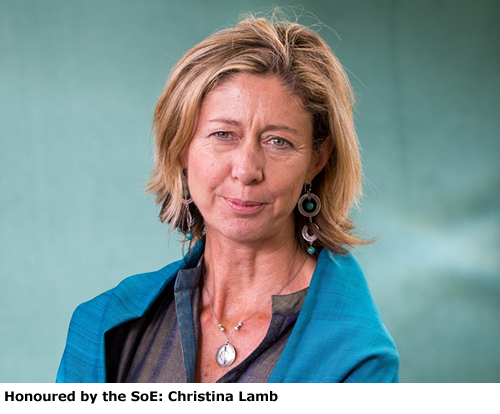
2. SoE honours foreign correspondent Christina Lamb
Congratulations to Christina Lamb, the chief foreign correspondent of The Sunday Times, who received an Outstanding Contribution to Journalism Award from the Society of Editors (SoE) during its Future of News conference in London.
The SoE said Christina has ‘brought the brutal reality of war home to all her readers’ in her recent despatches from Ukraine and that ‘there was no better example of the power of story-telling’.
Accepting the award via a pre-recorded message from where she was filing from the east of Ukraine, Christina explained that although some of the things happening in war-torn Ukraine were ‘horrific’ and ‘uncomfortable’ to watch and read, this made it ‘more incumbent’ for journalists to report on it.
She told the conference: ‘Most of us do this job, partly because it is so fascinating, but also because we want to expose injustice and to make a difference. Personally, the hardest thing for me is when I pour my heart out writing something and nothing changes. These days, we stay in touch with those we interview through WhatsApp and Messenger, and I find it heart-breaking when people message: I told my story but what difference does it make? I hope fervently that with this war in Ukraine, as there is so much interest, that it will make a difference’.
London-born Christina, 57, who is also a best-selling writer and author of nine books, has reported from most of the world’s hotspots in a stellar career, beginning with Afghanistan in 1987. Her despatches from the Soviet-Afghan War led to her being named Young Journalist of the Year.
She has now won 15 major journalistic awards including the Foreign Correspondent of the Year honour five times, as well as Europe’s top war reporting prize â the Prix Bayeux â Calvedos, and was Feature Writer of the Year in last year’s SoE awards. She has an honorary degree from Dundee University and was awarded an OBE for services to journalism in the Queen’s Honours List in 2013.
Full coverage of the SoE conference can be sourced at www.societyofeditors.org and via @EditorsUK.
3. Rich List values DC Thomson family at £1.585bn
The Thomson family, who own Dundee-headquartered newspaper and publishing group â DC Thomson â are the seventh richest family living in Scotland according to the newly published 2022 Sunday Times Rich List, which also interestingly reveals that we now have 10 billionaire families in Scotland. The Thomson family fortune is put at £1.585bn.
Danish-born fashion tycoon, Anders Holch Povlsen, who lives in the village of Tongue, in Sutherland, is reported to be the richest Scottish-based person, with his personal fortune increasing by £500m in the past year to a staggering £6.5bn. He is Scotland’s biggest private landowner, with 12 Highland estates in his land portfolio, covering some 220,000 acres. He owns the Danish fashion retailer Bestseller and has a 25% stake in British online fashion retailer ASOS.
The Rich List’s Scottish top 10 is:
1. Anders Holch Povlsen (retail and land: £6.5bn)
2. Glenn Gordon and family (whisky: £3.395bn)
3. Kiran Mazumdar-Shaw and John Shaw and family (£2.496bn)
4. Sir Ian Wood and family (energy industry: £1.819bn)
5. Mohamed Al Fayed and family (Harrods: £1.699bn)
6. Mahdi al-Tajir (Highland Spring: £1.685bn)
7. The Thomson family (DC Thomson: £1.585bn)
8. Sandy and James Easdale (£1.363bn)
9. Lady Philomena Clark and family (Arnold Clark: £1.267bn)
10. Trond Mohn and Marit Mohn Westlake and family (industry: £1.245bn)
The 2022 Sunday Times Rich List is based on identifiable wealth, including land, property, other assets such as art and racehorses, or significant shares in publicly quoted companies. It excludes bank accounts.
4. Get your entries in for the British Journalism Awards
Entries are now open for the 11th Press Gazette British Journalism Awards. The event celebrates the best public interest journalism produced for a UK audience and is open to all publishers and journalists whatever the medium: print, broadcast and online.
To qualify for inclusion, work must have been published between 1 September 2021 and 31 August 2022.
The categories include: Arts and Entertainment; Business; Finance and Economics; Campaign of the Year; Comment; Crime and Legal Affairs; Energy and Environment; Features; Foreign Affairs; Health and Life Sciences; Innovation; Interviewer of the Year; Investigation of the Year; Journalist of the Year; Local Journalism; The Marie Colvin Award; News Journalist of the Year; News Provider of the Year; Photo-Journalism; Politics; Public Service; Scoop of the Year; Specialist Journalism; Sport; Social Affairs, Diversity and Inclusion; Technology; Built Environment Journalism; Personal Finance; and Travel.
The principal sponsor is Starling Bank and the other sponsors are Google, News Initiative, Camelot and wig.
5. Regional newspapers join Readly e-reading platform
Reach plc’s more than 160 UK regional newspapers have joined the Readly e-reading platform which allows users ‘all-you-can-read’ access to view unlimited content for a flat rate of £9.99 a month. More than 6,300 titles are available to subscribers.
Welcoming the Reach plc initiative, Ranj Begley, the chief content officer at Readly, told media industry website HoldTheFrontPage (HTFP): ‘At a time of verified journalism and trusted news being so important, we are delighted to welcome such a broad offering of regional newspapers to our platform. Read locally and across the UK, we know that our subscribers will be eager to read their favourite regional newspaper, alongside the broad range of titles available as part of a Readly subscription.
‘The focus on strengthening our newspaper portfolio continues and data shows that access to newspapers on Readly increases reading engagement. We can see that reading activity is increasing â both total reading time and average reading time â and we have noted a significant increase in subscribers who use our app on a daily basis.’
6. Mike Edwards honoured for military charity work
Inverness-born retired journalist, Mike Edwards, who currently writes a fortnightly column for the Helensburgh Advertiser, has earned a top military award for his voluntary work. Mike, who has been an Army Reservist for close on 30 years, was named Reservist of the Year in the Scottish Veteran Awards.
During his journalistic career, Mike worked for Radio Forth, Radio Tay, Moray Firth Radio, The Press and Journal (P&J) and the Swiss Broadcasting Corporation, latterly spending 26 years on the reporting staff of STV. He retired in 2019.
Mike received the award in recognition of his work with a variety of good causes connected with the armed services, especially for his work with Erskine, the charity for former forces personnel.

Should you wish to get in touch with me, please email me at: mackay858@btinternet.com