1. Demise of The Dumbarton Democrat after a five-year run
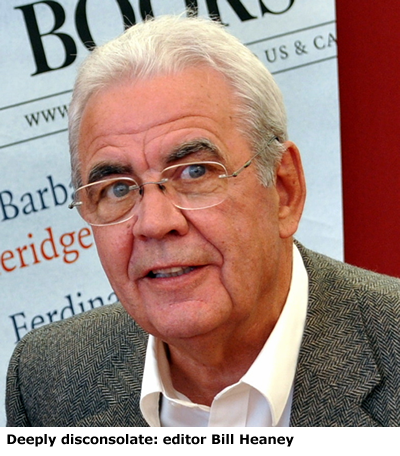
One of Scotland’s preciously few independently-owned digital news platforms, The Dumbarton Democrat, has been forced to close and is looking for a new owner. The outlet is owned and edited by Bill Heaney, 74, one of Scotland’s best-known, iconic journalists: 60 years in the business: a former editor, at 21, of the Dumbarton Reporter, editor of the Lennox Herald, regional editor of the Scottish & Universal Newspapers group and three times voted Scotland’s Weekly Journalist of the Year.
On the enforced demise of his always informative news outlet, a deeply disconsolate Bill writes: ‘Although successful in attracting many thousands of readers each week, The Dumbarton Democrat can no longer sustain the level of news coverage it has during the past five years.
‘All our reports, news and sports coverage, comment and features, and even community-based advertising, have been brought to readers free of charge over that period, despite the fact that West Dunbartonshire Council has refused to recognise our status as bona fides journalists and discriminated against us on a regular basis by refusing to adhere to the usual customs and practices which attach themselves to the freedom of the press ethos.’
Bill reveals that approaches to the council’s new Scottish Labour Party-run administration have led to no indication of any change to that stance, and tells us: ‘We are hopeful that some other well-intentioned news organisation or philanthropic individual will step into the breach as both of Dumbarton’s current local newspapers have closed their local offices and no longer accommodate editorial staff within the community. They now sell only a small percentage of copies in comparison to what they sold in the past’.
However, Bill must be touched by how his readers have reacted with deep disappointment to the closure. Jim Bollan perhaps typifies their immediate response, declaring on The Democrat’s website: ‘Freedom of speech and expression are critical. And you served this purpose over the years. There will be a huge sigh of relief from those who do not want a light shone in dark corners in seeing you retire because you were a thorn in their flesh for many a year. Thanks for holding the local establishment to account for as long as you did’.
2. Congratulations to newly-knighted crime author Ian Rankin
We were very pleased to see prolific Scottish crime author, Ian Rankin, knighted in the Queen’s Platinum Jubilee Birthday Honours. Sir Ian is one of Scotland’s unassuming, really good guys and well deserves this accolade for services to literature and charity. (I would love to know who sponsored him!)
Sir Ian, 62, an Edinburgh University graduate, is known across the world for his crime novels focused on police detective Rebus, which are mostly based in and around Edinburgh. Knots & Crosses, the first in the series, was published in 1987. They have been translated into 26 languages and have become bestsellers on several continents.
Retired newspaper, radio and TV journalist, Mike Edwards, 57, is honoured with an OBE for public and charitable service in Scotland. Mike, a deputy Lord Lieutenant of Dunbartonshire and a major in the Army Reserve, has been given the OBE principally for his work on behalf of armed forces charities.
Surprisingly, the only other media person I can see on the 1,000-plus honours list was broadcaster Clare Balding, 51, who has become a CBE for services to horse-racing and charity.
3. Can Scotland support a new quality business magazine?
Reach plc’s decision to axe the Scottish Business Insider print magazine after a 38-year publication, has prompted a debate on whether there is really room in Scotland for a new quality print business magazine.
The debate has ensued after Insider’s final editor, Kenny Kemp, claimed: ‘Scottish Business Insider magazine did not fit with the company’s wider search for digital clickbait and celebrity trivia,’ adding: ‘Scotland requires independent and balanced business reporting now more than ever. I am convinced that a quality magazine that is thoughtful can survive in Scotland â supported by our professional classes. We can’t blame Reach for their commercial decision, but I have to reflect… that Scottish Business Insider was in the wrong ownership hands’.
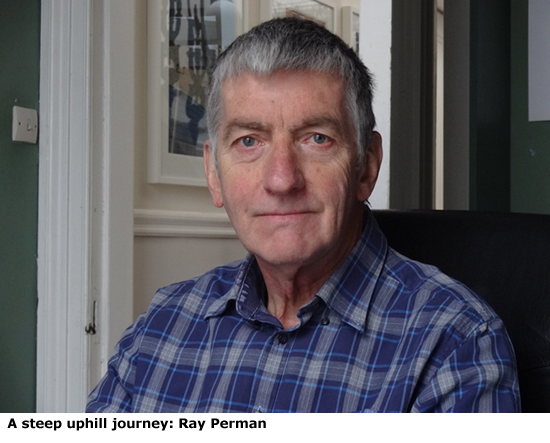
So whom better to give us a considered opinion on whether Kenny is on the right track or not than Ray Perman, co-founder of the Insider back in 1984, along with fellow journalist Alastair Balfour. After successfully publishing the magazine for 15 years, and consistently in profit after year two, they were made an out-of-the-blue multi-million pound offer they simply couldn’t refuse from Trinity Mirror (now Reach plc) â publisher of the Daily Record and Sunday Mail.
London-born Ray, 74, after a period as Labour reporter for The Times, had headed north to Edinburgh and was briefly on The Scotsman staff before serving the Financial Times as its Scottish correspondent from 1976 to 1981. He then joined the newly-launched Sunday Standard newspaper and was deputy editor when it closed in 1983.
Using his redundancy money, he joined forces with Alastair Balfour, the Sunday Standard’s business editor, to launch Scottish Business Insider in April 1984 â very aware that the Sunday Standard had been much admired for its business coverage and they capitalised on that goodwill in launching Insider which, at its peak, had an editorial staff of 10, plus a team of regular freelances.
From his Edinburgh home, where nowadays he is an author of some renown, with three books under his belt and a fourth due out shortly, Ray explained to me: ‘We were ground-breaking in our use of technology with the Insider in reducing production costs, although the systems which we used 38 years ago would be unrecognisable today in the world of digital printing.
‘But costs are only half the equation when it comes to commercial viability. We were mostly supported by advertising revenue and had very little competition for the budgets of companies which wanted to reach a business audience with colour ads.’
Now, he points out, advertising has largely moved online where costs are lower and the impact can be measured immediately and with vastly increased accuracy.
Ray asserts: ‘It would be very hard with a new publication to achieve the premium rates we were able to command for full-page colours ads in the 1980s and 1990s. However, changes in publishing are not the only factor. Another factor is the way the Scottish business bases have changed. There are more firms now than there were in 1984 but the number of large, independent and important companies has shrunk’.
He reminds me that there were four banks, two of which, the Royal Bank and Bank of Scotland, were in the top 100 companies quoted on the Stock Exchange. There were 11 life assurance offices and one major commercial insurer, General Accident, based in Perth. A large part of the whisky industry was owned and managed in Scotland and there was an important manufacturing base with engineering companies like Weir Group, Motherwell Bridge and Anderson Strathclyde.
North-east Scotland was the European base of oil majors, plus a myriad of local support firms including the Wood Group. Dundee had Timex and NCR to supplement jute, jam and journalism. There was Stakis Hotels, Scottish & Newcastle beer, several paper mills, Kwik-Fit tyres and Morrison and Lilley in the construction industry.
Ray explains: ‘For us that meant plenty to write about. We knew the chief executives of these companies â they were much more accessible than if we had all been based in London. And they all used local support services: accountants, lawyers, PR and advertising agents, headhunters and IT consultants.
‘If it was easy to talk to them, it was also easy for Diana Griffith, our sales director, to sell to them. We invented ways to attract their attention and meet them face-to-face: the Insider Top 100 Companies (which grew over time to the Top 500); the Corporate Elite: profiles of those who ran major Scottish enterprises provided the text for our largest revenue-earning issue of the year and the pretext for a grand dinner, which, of course, we got sponsored. Deals and Dealmakers was our way to getting into the growing venture capital and entrepreneurial sector. Exciting new-start companies did not have big marketing budgets but those firms which advised and invested in them did.
‘That end of the market is still there, and Insider, under a succession of editors, has had a creditable record in covering and nurturing it. But many of the big firms have been swallowed up; gone bust; or are now owned from outside Scotland. The distinguished businessman, Sir Ewan Brown, has listed 34 firms which have gone during his business lifetime.
‘And I can think of a few more. With them has gone top decision-making. Advertising agencies tend to cluster where marketing directors are located, and it is very much harder for a Scottish-based business magazine to sell to a London-based advertising agency.’
Thus Ray somewhat reluctantly concludes: ‘I admire Kenny Kemp’s positive attitude and entrepreneurial spirit, but if he wants to put his words into practice, he faces a steep uphill journey’.
4. A glorious day, even for the Prince of Wails
A large headline in The Telegraph on its front-page colour piece by Allison Pearson on the Platinum Jubilee celebrations read: ‘A glorious day, even for the prince of wails’. There was certainly a large element of poetic licence about that headline as Allison had only mentioned the Prince of Wales as being ‘pensive’ at the Trooping of the Colour ceremony. Readers were somewhat confused by the headline, with Kerro Panille remarking in the comments section: ‘Prince of Wails â thought at first you were talking about Harry’.
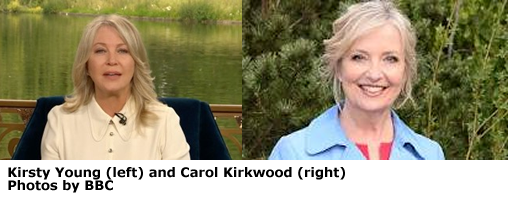
Allison was on safer ground when she enthused: ‘Kirsty Young anchored the BBC’s television coverage with a lovely, warm, generous serenity. Mercifully, there would be no repeat of the inane drivel during the Diamond Jubilee and the dire Thames Pageant’.
The Scottish broadcaster, 53, returning to broadcasting after a four-year absence since being laid low by the very painful affliction fibromyalgia, performed impeccably and was widely praised, including from perceptive columnist Sarah Vine in the Scottish Daily Mail, who wrote: ‘I had forgotten how good she is, how she brings a sense of quiet intimacy to the most public of moments. There aren’t many women broadcasters of her calibre around’.
And I was delighted that Carol Kirkwood’s debut in news reporting, from Scotland in the BBC’s Jubilee television coverage, went really well. I have a soft spot for the BBC Breakfast’s star weather forecaster, one of a family of eight who was brought up in the small Inverness-shire village of Morar, where her folks ran a hotel. And I would urge the BBC bosses to give Carol, 60, a shot at more demanding presenting duties on one of its numerous news and current affairs programmes, just to see how she fares.
Should you wish to get in touch with me, please email me at: mackay858@btinternet.com
Caithness-born Hamish Mackay is now in his 57th year as an occasional/sometimes regular contributor to the UK’s exceedingly diverse media market