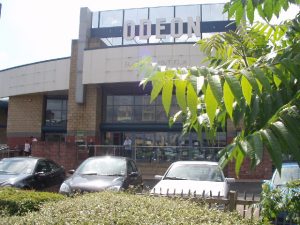
Shopping centre, Glenrothes. Photograph by Islay McLeod
In the course of his trenchant critique of Glasgow City Council’s mishandling of the plans to redevelop George Square, Andrew Hook (17 January) refers to the depressing sight of ‘once proud Sauchiehall Street’ sliding into ‘increasingly shabby and dismal decline’.
Residents of Glasgow will recognise his description and a similar pattern of deterioration can be seen in many towns and cities across Scotland. Walk down any high street and the chances are that there will be a fair number of unoccupied shops, as well as several charity outlets on short-term leases. It is estimated that there are some 20,000 empty shops in Scotland, representing nearly 15% of all retail units. The recent news about HMV and Blockbusters going into administration, and Jessops closing its stores, continues the trend, with significant job losses for hundreds in Scotland and thousands across the UK.
These latest casualties can partly be accounted for by developments in technology: people no longer rely on CDs and DVDs to access music and film to the extent that they did in the past, and camera phones are now commonplace. Again, for many people, the ease of online shopping enables them to avoid the hassle of a trip into town, with attendant problems of congestion and parking.
It is tempting to explain what is happening in purely economic terms, as a symptom of the continuing recession and the failure to stimulate growth. That is certainly an important part of the story but it fails to capture the full extent of the problem. The Scottish Government set up a National Review of Town Centres in September last year, under the chairmanship of Malcolm Fraser, a leading Scottish architect. In a press release it was stated that the aim was to produce ‘an action plan for re-energising Scotland’s town centres, addressing issues associated with planning, rents and rates, competition and empty properties’.
Nicola Sturgeon, deputy first minister and cabinet secretary for infrastructure, investment and cities, added: ‘Town centres are vital to the economic and social fabric of Scotland – they are the heart of our communities, offering a base for small businesses to thrive, and providing a focal point for social interaction’. Her reference to the social function of town centres extends the discussion beyond narrowly economic considerations and highlights the fact that to encourage people into urban centres requires more than simply attractive shops: it needs to take into account changing patterns of working and living.
The report of the review group is expected in April. A conference to explore some of the issues was held in November 2012 and identified a number of key services which an effective town centre should provide, over and above a wide range of retail businesses. They include safety and security: many older people do not feel safe in city centres, particularly at night. At the same time, there need to be venues that attract young people, who can bring energy and a sense of fun to urban life.
The environment should have a distinctive cultural and community identity, reflecting local history and traditions: too many town centres look the same, lacking a unique sense of place. They should encourage diverse activities, including leisure and learning, tourism and entertainment. Practical considerations such as good signage, traffic-free areas and ‘weather proofing’ are also seen as important.
Significantly, the conference highlighted the need for trust between local authorities and community groups when proposals for development are being considered. In the absence of trust, ill-judged decisions can be driven by self-interested power struggles rather than by a fair assessment of what is in the interests of the community.
Scotland’s recent record in the field of town planning is not impressive. The controversial ‘Plook on the Plinth’ award, given annually to the most dismal town in Scotland, aims to draw attention to the negative effects of environmental ugliness. Previous winners have included Linwood, Glenrothes and Cumbernauld. It invariably provokes hostile reactions from local dignitaries who protest that it is an insult to their community and the people who live there. They are missing the point.
The award should be seen as a judgement on the leadership of the locality, the councillors and officials who have allowed the decline to take place, and who have given approval to inappropriate and unattractive developments. Although they cannot be held responsible for the wider economic problems affecting the whole country, they need to bear some responsibility for the visible signs of neglect and poor planning that the local citizens have to confront on a daily basis.
In the run-up to the creation of the Scottish Parliament, one of the frequently expressed hopes was that it would encourage an enhanced degree of ‘civic activism’, with greater democratic involvement of ordinary folk in decisions that affect their lives. To date we have seen limited evidence of this, a situation which suits most politicians quite well, despite their rhetoric of ‘listening’ and ‘engagement’.
Perhaps the reaction to the George Square proposals marks a turning point, an assertion of the right of the public to be heard – as distinct from being ‘managed’ through some questionable ‘consultation’ process. If that turns out to be the case, and the results can be seen in more attractive and vibrant town centres, maybe the time would be ripe to introduce a more positive award than ‘Plook on the Plinth’ – perhaps one for the ‘Most Improved Town in Scotland’.
The criteria for such an award should not simply be gauged by the amount of commercial activity that occurs, but should also take account of the quality of the built environment, the diversity of the social, cultural and educational activities, and the extent to which people experience a sense of wellbeing when they visit.
 Walter Humes held professorships at the universities of Aberdeen, Strathclyde and West of Scotland and is now a visiting professor of education at the University of Stirling