

With a week’s leave left to take, an article in The Guardian furnished me with a destination. I had never heard of Zaragoza, but that made it all the more intriguing. Having explored Spain thoroughly since I was a teenager, I had never made it to Aragón. And I soon realised that while interesting enough in itself, Spain’s fifth city would provide a convenient launchpad for two interconnected interests: trains and the Spanish Civil War. Â
Â
Although overshadowed by the global conflict that followed in its wake, the Civil War was a battle between progressives and authoritarians then typical of 1930’s Europe. The Republican side drew recruits from all over the world, most famously Eric Blair (George Orwell). I didn’t make it to the ‘route’ named after Orwell in the hills of Aragón, but I did make it to the village of Belchite, which is about an hour by bus from Zaragoza.Â
Â
‘New’ Belchite is unremarkable, but walk a few yards to the east and you encounter a fenced off area containing what remains of ‘Old’ Belchite. On 24 August 1937, Republicans attacked the village, the tactical aim being the conquest of Zaragoza, but more pressingly to relieve pressure on collapsing Republican defences at the northern front (several thousand Nationalist troops were stationed in Belchite). Â
Following heavy aerial bombardment, house-to-house combat fell to the 15th International Brigade, which mainly comprised Canadian, American and British fighters. Fighting raged until Belchite was taken on 6 September, and restarted when Nationalist forces seized it back in March 1938. There wasn’t much left. At the end of the Civil War, the village was gradually abandoned, the result (so an information panel informed me) ‘of political decisions and propaganda by the victorious side’. Â
Â
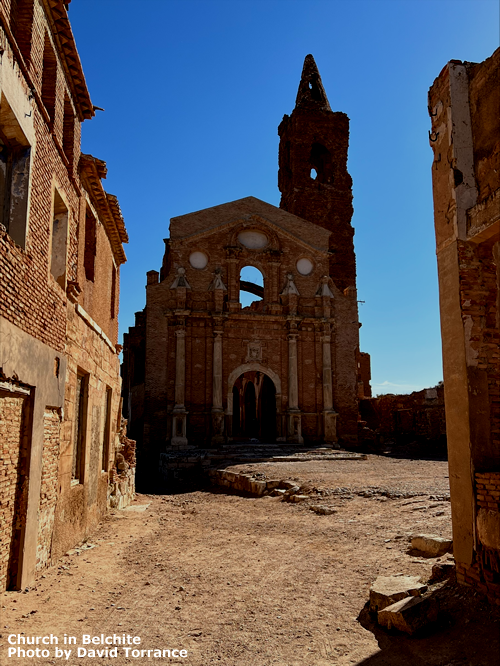
Today, Belchite is a hugely atmospheric film set and a living memorial to a conflict that’s fading from the public consciousness. My 90-minute guided tour was only in Spanish, but it didn’t matter; I’d come to see the buildings, for ruins have long fascinated me. Two of Belchite’s most evocative were two large churches which bookended the village. Although their respective facades are intact, inside the autumn sun shone through shell-damaged domes and roofless naves. Â
Â
Until recently, Canfranc International Station in northern Aragón was another living memorial, or rather a sprawling white elephant. The idea of connecting Pau (France) to Canfranc via the Pyrenees had been around since 1853, but France dragged its feet. Claiming lack of space, the Spanish searched for a suitable location on the other side of the border. Finally, an international treaty signed by both countries in 1904 committed them to complete the tunnel and station infrastructure. Â
Â
Drilling began in 1908 and the station was opened â following a lengthy delay caused by the First World War â by King Alfonso XIII of Italy and President M Gaston Doumergue of France 20 years later. Canfranc had an unlucky first decade. No sooner had it opened than the Great Depression hit, while in 1931 a fire devastated much of the fledgling station buildings. In 1936, it was occupied by the Spanish Army. They walled up the tunnel to prevent any French incursions. Â
Â
Canfranc somehow survived another world war and fire which destroyed more than half its homes. Although cross-border traffic increased until around 1965, in March 1970 a small French goods train derailed and destroyed the L’Estanguet Bridge. It was never rebuilt. According to the 1904 treaty, France’s railways (SNCF) must restore the link, which after more than half a century has yet to happen. The Government of Aragón, meanwhile, bought Canfranc station in 2013 and opened a ‘new’ international station just a few weeks before I visited.
I got there by train, a no-frills two-carriage service which departed Zaragoza from an almost completely deserted suburban railway station. The only other two passengers boarding at 08:55 looked as surprised as I did when it rolled into view. About an hour into the journey, our train changed direction and gradually made its way through the dusty landscape of the Pyrenees.Â
Â
Three-and-a-half hours later, a much fuller train arrived at an 800-feet-long railway station with as many windows as there are days in a year. Even when it opened in 1928, the architectural style of Canfranc station was overblown and dated. I regretted not having seen it in a more dilapidated state, for it is now undergoing conversion into a luxury hotel, as if the world needs any more of those. Â
Â
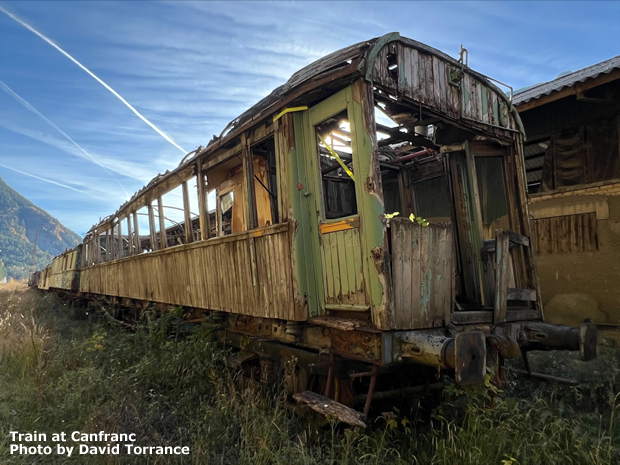
After a typical Aragónese lunch (these come with a bottle of red and no limit on consumption) I hiked around the station, taking in some more Civil War (and Second World War) infrastructure (concrete shelters) and the crumbling remains of mountainside canals. Just as I was returning to Canfranc proper, I stumbled across some decaying rolling stock near a cement factory, just what I’d hoped to see. I was probably trespassing, but it made for some highly instagrammable content.
I also found the old Somport international tunnel close by, still sealed off and emblazoned with a plaque recording the centenary of the tunnel ‘hole-through’ in October 2012. Nearby were the remains of huts once occupied by carabineros (frontier guards). The tunnel looked too small for modern rolling stock. Â
Â
The next morning, I was on another train, one of several high-speed services which now cover the 200 miles between Zaragoza’s modernist Delicias station and Madrid’s Atocha in 80 minutes. I chose not to linger at Atocha but instead caught a regional service to El Escorial, about an hour north-west of the Spanish capital. Although a strikingly beautiful town, it wasn’t my final destination. I wanted to see the ‘Valley of the Fallen’. Â
Â
One got the sense the Spanish authorities aren’t terribly keen on tourists visiting this site, a gargantuan memorial to the thousands of Nationalist and Republican soldiers who died in the 1936-39 Civil War and, until recently, the final resting place of Franco himself. His body was moved (amid great pomp) to a provincial Madrid cemetery in 2019, but the whole set up clearly remains something of an embarrassment to a country which would rather forget about this chapter of its history. Â
Â
There is one bus a day from El Escorial. It isn’t advertised online and even at the bus station is only denoted with a discreet ‘vl’ (Valle de los CaÃdos) on the printed timetable. I was the only passenger and the driver â clearly unfussed by any historical controversy â cheerfully flagged the best photo opportunities as we sped up the hillside. Virtually deserted on another crisp autumn day, I had a couple of hours to take in the cavernous, leaking basilica and the peaceful monastery situated above.
Back in Madrid, I found a curious replica of the pock-marked Puerta del Carmen in Zaragoza, a relic not of Spain’s Civil War but its liberation from Napoleonic French rule. It’s one of several historical buildings which were recreated for the Feria del Campo, an annual agricultural show associated with the Franco era. The Puerta del Carmen (an arched gateway) formed part of the Aragón pavilion.
Like the Valley of the Fallen, what remains of Feria del Campo has been ignored and neglected rather than removed. Some of the other pavilions have been repurposed as restaurants â none busy as a consequence of the pandemic â while at least one acts as a shelter for some of Madrid’s homeless. A complicated thing, history, and Spain is full of it. Â Â
David Torrance is a writer and historian