1.
The BBC dominated proceedings in the Royal Television Society Scotland Awards 2021, winning 17 of the 22 categories at stake. The awards were announced via a virtual ceremony hosted by Scottish comedian and presenter Des Clarke.
The RTS Scotland Awards celebrate excellence in television across a range of platforms and aim to recognise the huge variety of skills involved in programme production.
BBC Scotland’s Murder Trial: The Disappearance of Margaret Fleming lifted three awards – top director; Factual: Documentary and Specialist; and Professional Excellence (Craft), Post Production: Editing.
Sky picked up two awards – Factual: Documentary and Specialist (Arts) and Sport: Live Event, while Channel 5 also won two awards – for Factual: Entertainment and Features along with the ubiquitous Susan Calman deservedly triumphing in the On Screen Personality category.
The Special Contribution Award has gone posthumously to South Uist-born Donald John Macdonald, editor of news at Aberdeen-based STV North for 13 years. He tragically died on Christmas Eve 2020 from a heart attack, aged only 60.
In tribute, RTS Scotland pointed out: ‘Through an esteemed career spanning four decades, Donald John was an enthusiastic supporter of future talent: generous with his time and the sharing of his experience to inspire new entrants to the industry. His passion for journalism, regional broadcast news and supporting new talent saw him make a huge impact on so many individuals and the industry in Scotland’.
The Outstanding Contribution Award went to Phil Differ and Jonathan Watson for the iconic Only an Excuse programmes which became an integral part of Scotland’s Hogmanay. Born from a one-off special on BBC Radio Scotland in 1986, it became a television show in 1993 and has entertained the nation every year until the final episode in 2020, with over 30 shows including specials and spin-offs over the years.
The RTS Scotland Award went to the Scottish production management community in general, ‘whose resilience and commitment ensured that television didn’t grind to halt a during the first year of the COVID-19 pandemic’.
Stephen O’Donnell, chair of RTS Scotland, told Scottish Review: ‘There is an incredible wealth of talent working in the TV industry in Scotland and we are delighted to recognise these people and productions through our awards. Every award â and nomination â is so well deserved, and we are particularly pleased to recognise the production management community in 2020 at what was an incredibly challenging time for the business; and to grant a posthumous award to Donald John Macdonald who made a huge impact on the Scottish broadcast news industry and was a real inspiration to new talent’.
For a full list of the awards and nominees, please visit https://rts.org.uk/award/rts-scotland-awards-2021
Meantime, here is an edited list of winners and nominees:
Director
Winner: Matt Pinder, Murder Trial: The Disappearance of Margaret Fleming, Firecrest Films for BBC Scotland
Nominees: Anne-Claire Pilley, Being Gail Porter, Tern Television Productions for BBC Scotland; and Stephen Bennett, Eminent Monsters, Hopscotch Films for BBC Scotland
Factual Daytime
Winner: Paramedics on Scene, Firecrest Films for BBC One
Documentary and Specialist Factual
Winner: Murder Trial: The Disappearance of Margaret Fleming, Firecrest Films for BBC Scotland
Current Affairs
Winner: Disclosure, Scotland’s Lockdown, BBC Scotland
Nominees: STV News, Scotland Tonight; and The Trial of Alex Salmond, Two Rivers Media for BBC Two
News
Winner: Eorpa, Episode 1 Slavery, BBC Scotland Productions for BBC Alba Nominees: STV News North, STV News at Six and STV North for STV, and The Nine, BBC Scotland
On Screen Personality
Winner: Susan Calman, Secret Scotland, IWC Media for Channel 5 Nominees: Amy Irons, BBC News for BBC Scotland
Sport: Live Event
Winner: Sky Sports, Serbia v Scotland
Nominees: BBC Scotland Productions for BBC Scotland, Sportscene: Scottish Cup Final; and Nemeton TV for BBC Alba, Womens’ Champions League, Glasgow City v Peamount United
Sport: Programme
Winner: The Women Who Built Glasgow City, PurpleTV for BBC Alba Nominees: A View From The Terrace, Studio Something for BBC Scotland; and The Boxer, Matchlight for BBC Scotland
Young Journalist
Winner: Hope Webb, BBC Scotland
Nominees: Brandon Cook, STV News for STV and Laura Alderman, STV News for STV
2.
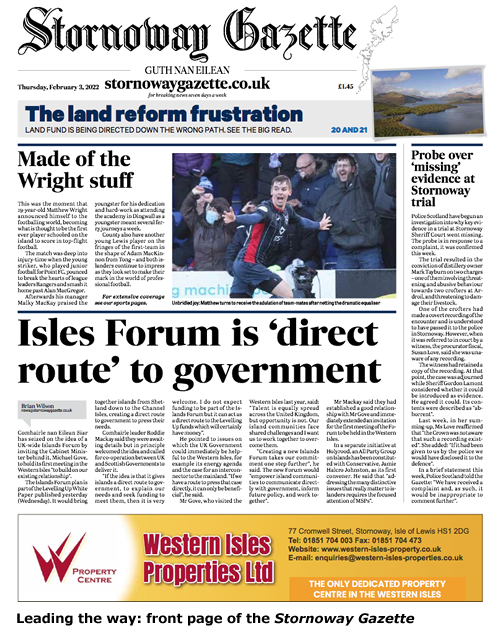
As I reported last week, the Stornoway Gazette was the only totally paid-for UK weekly newspaper to increase its circulation last year according to the latest data from the Audit Bureau of Circulations (ABC).
The average weekly sale of the bilingual weekly, owned by JPIMedia, increased by 18% to 2,698 copies as it hugely benefited from the enthusiasm and expertise of its new editorial team: editor Murray MacLeod and editor-at-large Brian Wilson. Considering that Murray and Brian only assumed their new roles in mid-April last year, that makes their achievement all the more creditable.
Against a backdrop of all the other Scottish weeklies featuring in the ABC statistics being hit by falling sales â ranging from -3% at the Arran Banner to -32% at the Hamilton Advertiser and Irvine Herald and Kilwinning Chronicle, the Stornoway Gazette’s success could realistically represent a circulation boost of around 30%.
Not all of our Scottish weekly newspapers have their circulations issued by ABC. For example, two of our leading weeklies, The Shetland Times and The Orcadian are not included, but here we list the 60 weeklies which do come under the ABC umbrella.
Based on the ABC figures, the top performer was the Dumfries & Galloway Standard which publishes on both Tuesdays and Fridays, with a combined sale of 8,344 copies. It is followed by The Falkirk Herald on 7,996; The Inverness Courier, 7,163; Ayrshire Post, 6,907; The Oban Times, 6,703; and Perthshire Advertiser, 5,105.
Among the newspapers with an average weekly sale last year of less than 500 copies were the Ellon Times, 135 (down 22%); the Fraserburgh Herald, 208 (-25%); the Mearns Leader and Kincardineshire Observer, Stonehaven’s local newspaper, 280 copies (-21%); the Galloway Gazette, 340 (-20%); Peterhead’s The Buchanie, 352 (-24%); the Glenrothes Gazette, 367 (-25%); the Banffshire Herald, 374 (-27%) and the Deeside Piper, 437 (-19%).
It is worth noting that six of these titles are within the circulation area of Aberdeen’s The Press and Journal (P&J), the UK’s top selling regional daily newspaper which has a marked emphasis on local news. The P&J had an average daily sale in the second half of last year of 27,632 copies.
Below are the circulation figures issued by ABC encompassing some 60 Scottish weekly newspapers. Other than the Stornoway Gazette, whose circulation rose by 18%, they are listed according to their percentage decrease in copies sold in 2021 compared to 2020:
Stornoway Gazette: 2,698 (up 18%); Arran Banner: 2,180 (down 3%); Ross-shire Journal: 2,544 (-4%); Dunoon Observer: 2,633 (-5%); Isle of Bute News: 797 (-5%); Oban Times: 6,703 (-5%); Annandale Observer: 3,075 (-5%); Strathspey & Badenoch Herald: 1,734 (-6%); The Inverness Courier (Friday): 4,835 (-6%) and Tuesday: 2,328 (-17%); Strathearn Herald: 858 (-7%); Northern Times (Golspie): 1,677 (-7%); Annandale Herald and Moffat News: 2,008 (-8%); West Highland Free Press: 3,692 (-8%); Galloway News: 3,396 (-9%); John O’Groat Journal: 3,160 (-9%); Campbeltown Courier & Argyllshire Advertiser: 3,494 (-10%); Dumfries & Galloway Standard (Friday): 5,437 (-11%) and Tuesday: 2,907 (-13%); Fife Free Press: 3,806 (-13%); Forres Gazette: 938 (-11%); Blairgowrie Advertiser: 815 (-11%); Falkirk Herald: 7,996 (-11%); Caithness Courier: 1,860 (-12%); Perthshire Advertiser (Tuesday): 1,570 (-13%) and Friday: 3,535 (-15%); Milngavie & Bearsden Herald: 1,118 (-13%); Huntly Express: 846 (-14%); Southern Reporter (Selkirk): 4,603 (-15%); Stirling Observer (Wednesday): 3,203 (-15%) and Friday -1,383 (-18%); Berwickshire News: 1,115 (-16%); Linlithgow Gazette: 1,489 (-16%); Kirkintilloch & Bishopbriggs Herald: 1,349 (-17%); Lanark & Carluke Gazette: 1,995 (-17%); Cumbernauld News & Kilsyth Chronicle: 749 (-17%); Deeside Piper: 437 (-19%); Lennox Herald: 2,561 (-19%); Banffshire Journal: 525 (-20%); Ayrshire Post: 6,907 (-20%); Galloway Gazette: 340 (-20%); East Fife Mail: 1,383 (-20%); Midlothian Advertiser: 725 (-21%); Mearns Leader and Kincardineshire Observer (Stonehaven): 280 (-21%); Motherwell Times & Bellshill Speaker: 1,271 (-21%); Fife Herald: 2,130 (-22%); Ellon Times: 135 (-22%); Banffshire Advertiser: 707 (-22%); West Lothian Courier: 2,093 (-23%); Kilmarnock Standard: 3,323 (-24%); The Buchanie (Peterhead): 352 (-24%); Berwick Advertiser: 1,281 (-24%); Wishaw Press: 1,836 (-24%); North Star (Dingwall): 533 (-24%); Fraserburgh Herald: 208 (-25%); Glenrothes Gazette: 367 (-25%); Rutherglen Reformer: 879 (-26%); Banffshire Herald: 374 (-27%); East Kilbride News: 1,721 (-28%); Highland News (Inverness): 853 (-31%); Airdrie & Coatbridge Observer: 2,154 (-31%); Hamilton Advertiser: 2,778 (-32%); and Irvine Herald and Kilwinning Chronicle: 1,131 (-32%).
3.
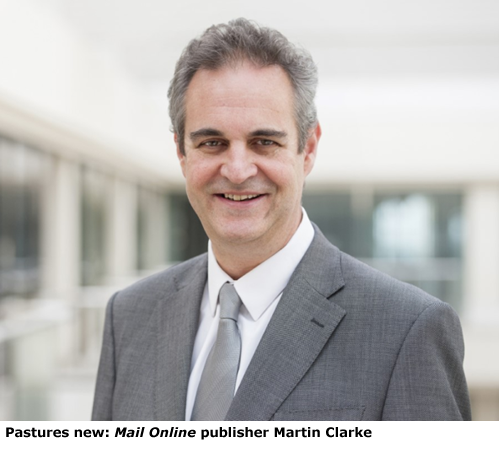
Martin Clarke, largely responsible for making Mail Online one of the leading and most read news websites in the world, is stepping down to explore pastures new. Martin, the publisher and editor of Mail Online, is very well known on the Scottish media scene having edited both the Scottish Daily Mail and The Scotsman as well serving as editor-in-chief of the Daily Record and Sunday Mail.
In his farewell speech to Mail Online colleagues, Press Gazette reports that Clarke joked that the website was an ‘overnight success’ that took ’13 years of blood, sweat, quite a lot of cigarettes and quite a lot of booze’. The current UK editor, Danny Groom, has been appointed acting global editor of Mail Online, overseeing its UK, US and Australian editorial operations.
Martin, a journalist for 37 years and an editor for 27, admitted that ‘being an editor does make you a monster. Or, in my case, more of a monster’. He has been colourfully described in the trade as having ‘the man-management skills of a galley-master on a Greek trireme’.
He told colleagues that heading Mail Online had made for ‘the best professional years of my life’ but that it was not a job he had actually wanted at the outset, explaining: ‘I assumed when they foisted it on me that I was being shafted. And maybe I was. But anyway, pretty quickly I realised that all that reader data you get instantly in real-time gave me, as an old-fashioned newspaper editor, superpowers. And I was addicted, and pretty soon so were the readers. I couldn’t imagine, within a few months, ever going back to a world where I produced one paper a day, or where you have to be pigeonholed as a broadsheet or a tabloid, or we have to guess what the readers actually wanted to read rather than instantly knowing for a fact’.
He claimed, however, that Mail Online is still like a newspaper in the sense that ‘the vast majority’ of its readers come directly to its homepage and app, which combined bring in 80% of its revenue, making it more ‘stable’ than others which rely on Google and Facebook.
In 2019, Mail Online’s search traffic halved after Google changed its algorithm, while last year the website claimed it was being downgraded in search results. ‘Every now and again, they tweak the algorithms,’ alleged Martin. ‘Some win, some lose: we usually lose if it’s Google. But it doesn’t matter to us. So long as we can keep people coming back to that homepage every single day over and over and over, you will be in jobs.’
He praised Lord Rothermere, its chairman, for taking Daily Mail General Trust (DMGT) private at the end of last year after nearly a century on the stock market, telling staff: ‘I think you should also bear in mind that he has just underlined his and his family’s commitment to the business of journalism by taking the company private and I think that’s a great thing to do’.
He said Lord Rothermere had ‘stood by’ Mail Online even when there were ‘a few people who were doubters, who maybe thought we were going down the wrong road. Now, we had to get over a few humps to get here. We had to design the website from scratch. I know every website looks a bit like us now, but they didn’t when we started. I remember when we redesigned the website and launched it, everyone laughed. All the people at The Guardian, in the trade press: I forget what they said but it wasn’t very complimentary. And I kind of panicked a bit and I thought shit what have I done, but then the traffic started just like that. And now, as you know, everyone copies us’.
He added: ‘Having designed the website, we couldn’t find a content management system to make it work, so we had to build one from scratch,’ emphasising: ‘It also took a lot of work to get our commercial strategy right. Under the leadership that we’ve now got⦠We’re now properly profitable’.
4.
Ultimately, but sadly predictably, a foreign journalist has been killed covering the war in Ukraine. Brent Renaud, 50, a US-born reporter and filmmaker, who had previously worked for the New York Times, was shot dead in the town of Irpin, outside Kyiv.
Kyiv’s police chief, Andriy Nebytov, said he had been targeted by Russian soldiers. Two other journalists were injured and taken to hospital. One of the injured journalists, Juan Arredondo, related that he was with Brent Renaud when they came under fire.
Arredondo explained: ‘We were across one of the first bridges in Irpin, going to film other refugees leaving, and we got into a car. Somebody offered to take us to the other bridge and we crossed a checkpoint, and they started shooting at us. So the driver turned around, and they kept shooting; there’s two of us. My friend is Brent Renaud, and he’s been shot and left behind… I saw him being shot in the neck’.
The New York Times said it was ‘deeply saddened’ to hear of Renaud’s death but that he had not been working for the newspaper in Ukraine. He last worked for the publication in 2015, the Times said, pointing out that the press ID he was wearing in Ukraine had been issued years ago.
NBC News said their ‘thoughts and prayers’ were with Renaud’s family and praised the ‘important contributions’ he made to NBC News reports but added that he was not working for them in Ukraine.
Renaud had worked for a number of US news organisations and had reported from Afghanistan, Iraq and Haiti. He won a Peabody Award for his work on a 2014 series on Chicago schools, Last Chance High.
US National Security Adviser, Jake Sullivan, told CBS News that the country could impose ‘appropriate consequences’ against Russia for Renaud’s death. He stressed: ‘This is part and parcel of what has been a brazen aggression on the part of the Russians: where they have targeted civilians, they have targeted hospitals, they have targeted places of worship, and they have targeted journalists’.
Renaud had been working on this Ukraine trip for Time magazine. Its editor-in-chief and CEO, Edward Felsenthal and Ian Orefice, the president and chief operating officer of Time and Time Studios, said they were ‘devastated by the loss’. A statement from the magazine said: ‘As an award-winning filmmaker and journalist, Brent tackled the toughest stories around the world often alongside his brother Craig Renaud’.
Renaud’s death came less than two weeks after Ukrainian journalist, Yevhenii Skaum, a camera operator for the Ukrainian television channel LIVE, was killed when a TV transmission tower in Kyiv was hit by shelling.
And Sky News chief correspondent Stuart Ramsay was shot and wounded in the lower back when he and four colleagues were ambushed while driving back to Kyiv. Ramsay was not seriously injured and is now recuperating back home in the UK.