A telephone is ringing in the darkness and snatches of conversation can be heard:
‘same slate’, ‘still running’, ‘cut-throat’…
‘Okay, Rick, whatâs the game?’
‘Cut-throat’
‘Whatâs the object of it?’
‘Object is to keep your balls on the table and knock everybody elseâs off.’
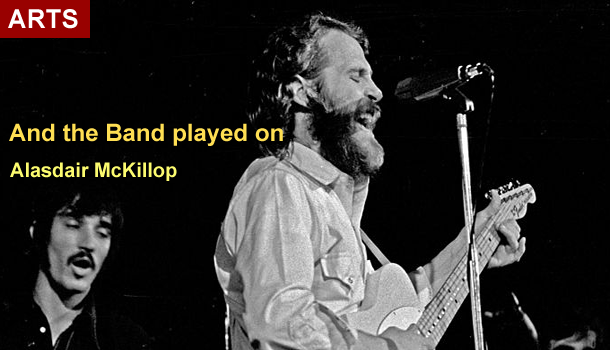
âThe Last Waltzâ could almost be the name of one of Martin Scorsese’s gangster films and if you were to play that dialogue for the uninitiated you might have a chance of fooling them. Instead, itâs the name of his famous documentary about the last concert given by the Band. The five musicians had once been the Hawks and would soon be the Band, a name they had come to by obscure and possibly accidental means, no more. In between, they were the accomplices who electrified Dylan and went subterranean with him during the ‘Summer of Love’.
They recorded two seminal albums in Woodstock before the flood at Yasgurâs farm and only after that did they bother to seek an audience as a live act. The music they recorded defied easy categorisation but all of the American southâs traditions flowed in and through them. The songs, taken collectively, evoked and continue to evoke not a mood, nor a specific time or place, but a dream-setting. Unlike most musicians, I donât first think of the Band in a recording studio or on a stage but somewhere with the smell of wood smoke on a winterâs night, the sound of water moving nearby, muddy boots, hot coffee and cold milk in glass bottles. The carnival is somewhere on the edge of town.
By the mid-70s, three of the five members of the Band were succumbing to addiction with a professionalism once reserved for making music. The groupâs guitar player and lead songwriter, Robbie Robertson, conceived the Last Waltz in an act of desperation. Recalling that period in his new memoir, Robertson writes: ‘packs of destructive influences showed up like they were in the business of helping you drown’. Part celebration, part commemoration and part salvation, the Last Waltz was intended to take the Band off the road and, just as importantly, keep it off.
The original idea was to stage a grand farewell concert with unannounced guests; the desire to film it came later. Robertson first met Scorsese at a screening of ‘Mean Streets’ in 1973 and had been impressed with the use of music in that film. As 1976 wore itself out, Scorsese was working on ‘New York, New York’ with Liza Minnelli but was unable to say no when asked if he would shoot the Thanksgiving day concert.
During the two months they had to prepare, Robertson provided Scorsese with the lyrics for the songs that would be played on the evening and the director transformed the information into a 200-page script with shooting instructions and sketches. It was László Kovács â the filmâs original director of photography before he gave way to Michael Chapman â who proposed shooting with 35mm film and Panavision cameras. No one, not even the manufacturer, was sure if the cameras would run for the duration of the concert but it was decided the improvement in quality was worth the risk.
The concert took place at Bill Grahamâs Winterland Ballroom in San Francisco. A former Ice Capades rink, the choice of venue had the same finality as the closing of a circle because it was there, in 1969, that the Band made its first serious appearance. To further distinguish the concert and film, the stage was elaborated using the set from the San Francisco Operaâs production of ‘La Traviata’. The neon branding outside Winterland might have been tiring but inside chandeliers were hung from the ceiling and careful attention was paid to the lighting. Footlights cast an amber glow on the stage, behind which were screens that would carry honeyed lighting.
To further heighten the sense of occasion, Graham decided a traditional Thanksgiving dinner would be offered to audience members before the concert â the ticket price was increased accordingly. According to the music journalist Barney Hoskyns, the 5,000 fans were confronted with 200 turkeys, 2,000lbs of candied yams, 6,000 rolls, 400 gallons of apple juice and 90 gallons of gravy. There were mincemeat and pumpkin pies in similar quantities. Bob Dylan had 400lbs of salmon shipped in from Alaska.
Shorn of false end-of-an-era portentousness, the Last Waltz couldnât help but look and sound great. Inevitably, there were certain performances and moments that carried its spirit better than others. There was Paul Butterfield holding a single note on his harmonica while accompanying Muddy Waters on ‘Mannish Boy’, just as Little Walter had on the original recording; Van Morrison kicking to the exclamation of the horn section at the end of ‘Caravan’; the glances and silent signals that help the Band and Bob Dylan move from ‘Forever Young’ to a chainsaw version of the folk song ‘Baby Let Me Follow You Down’; and Mavis Staples whispering ‘beautiful’ just before the scene changes after ‘The Weight’.
I like, too, the orange light in the darkness behind Levon Helm as he sang the first verse of ‘The Weight’ because I imagine it to be a blood moon waxed fat and undisguised. And when the reserve shot during ‘Mystery Train’ caught Richard Manuel hustling away at the second drum kit, he seemed to be moving like a man with a mugging on his mind. By the time the Band re-emerged at 2.30am to play their version of Marvin Gayeâs ‘Baby Donât You Do It’, six hours had passed since they started with ‘Up on Cripple Creek’. The fans, some of whom were filmed in Novemberâs natural light as they queued to enter Winterland, seemed in no need of a reprieve.
The concert and film are not unblemished. The treatment of Joni Mitchell in both is inescapably shabby but Levon Helm emerged as the most intransigent critic. The only American in a group of Canadians, Helm, had a voice that was probably responsible for curling Don Henleyâs hair. He grew estranged from Robertson, partly because of difficulties arising from his own drug use and partly because of the money Robertson had earned as the credited writer of most of the Bandâs songs.
Aggravating things further, Helm, with some justification, felt the concert and the decision to come off the road had been driven by Robertson. The reverential treatment given to the guitar player in the film when it was released in 1978 sealed a lasting bitterness. Robertson, a natural storyteller, served as the filmâs producer and, by his own admission, Scorsese didnât really know the other members of the group. The two men lived together while the film was being prepared for release and they maintain a relationship to this day. Robertson would gift the 1957 Fender Stratocaster he played at the concert to Scorsese.
Tellingly, itâs not until close to the mid-point of the film that Helm features in one of the interview scenes recorded at Shangri-La, the former bordello off the Pacific Coast highway that served as the Bandâs clubhouse. Throughout, he is uncharacteristically diffident, guarded by whiskers and bunkered under a truckerâs hat.
The dialogue quoted above is taken from the start of the film. Itâs preceded by a written command to the viewer: THIS FILM SHOULD BE PLAYED LOUD! Despite recalling Bob Dylanâs famous post-Judas instruction to the musicians who would become the Band, it feels out of keeping with the ethos of the group. The qualities that distinguished the Band, the qualities that contributed to the split of Cream and beckoned like a flame to Van Morrison and George Harrison, had nothing to do with volume.
The final scene is the most elegant of the whole film and much more fitting. In a single shot, the camera moves across the Band as the lighting changes and the shadows are rolled up tall on the background; smoke moves around as the camera starts to slowly withdraw; two rows of circular lights leading away from the group slowly accumulate along with the distance; darkness starts to account for more of the space and the Band becomes faraway and lacking in detail. I like to imagine that the smoke is not smoke at all but a haar coming ashore and that the lights stand on either side of a pier at the end of which, with backs to the sea, the Band plays on.