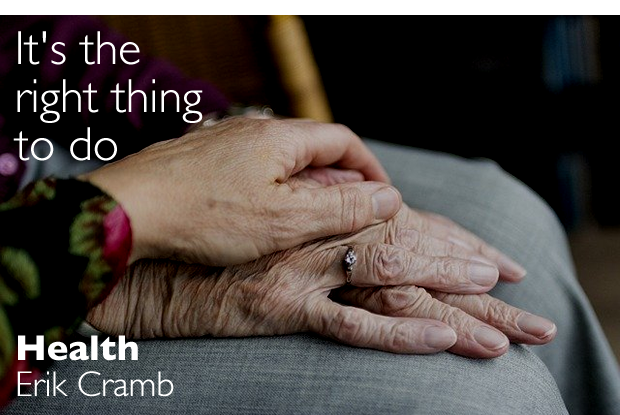
I have been reviewing the Scottish Government’s National Care Service consultation paper for Dundee Pensioners’ Forum, as we hope to be able to make a positive contribution to the setting up of a National Care Service. We believe this is the most aspirational and inspirational proposal emanating from any government since the creation of the National Health Service.
There is an old hymn which many of us older folks might remember from Sunday School. The chorus goes: ‘Count your blessings, name them one by one, and it will remind you what the Lord has done’.
These last 18 months or so have been hard for most of us. For some, especially those who have lost loved ones in the pandemic, it has been harder. Hopefully there is some light at the end of the tunnel, but it would be no bad thing to stop for a few moments to count your blessings, something for which there is no religious requirement, nor is there any age limit.
No family is perfect. We all have an aunt or an uncle who is a right pain in the neck, or a niece or nephew who is a total embarrassment, but for the most part we count our parents, our brothers or sisters, our partners, our children as blessings in our lives. Think about that for a moment. Hopefully in our list of blessings there will be a colleague or two and some neighbours. Even the imperfect in your life can be a blessing. You might be a member of the Tartan Army or even support Partick Thistle.
These are all very personal or individual blessings, but what would we count as our collective blessings? I’ll come back to that in a moment.
I often enjoy the Sunday night radio programme Your requests with Gary Innes. Requests are largely for familiar Scottish tunes, energetic eightsome reels, slow St Bernard’s waltzes, ‘Step we gaily on we go’, ‘Campbeltown Loch I wish you were Whisky’, and the like. Many of these requests are for loved ones far away, the Scottish diaspora, and I am reminded that there’s none like the Scots abroad for a longing for the heather and the hills, even if in my case the hill that was most familiar was Maryhill.
In 1980, Jamaica had a very violent election in which over 800 people were shot dead. Many of the clergy there had had very high political profiles and for the safety of their families had to leave Jamaica. The churches were faced with a chronic shortage of ministers, and, despite quite rightly not wanting the return of white men to their pulpits, put out requests to partner churches, including the Church of Scotland, for ministers who would come for no more than three years. It was to be a kind of ‘holding the fort’ operation.
The presbyterian church in Kingston contacted the Kirk looking for someone who was an experienced inner-city minister. I had been eight years in the Gallowgate in the East End of Glasgow and was needing a new challenge. Our oldest daughter was nine. Three years would mean we could be back home for her to start secondary school, so it seemed to be a good idea at the time. It was indeed. It was terrific, terrible and everything else in-between.
It was a quick learning curve. The regular temperature was around 30 degrees centigrade, so I worked in the morning, had a nap after lunch, then Elizabeth and I would pick up the children from school and go for a swim in the grandiosely named Mayfair Hotel’s pool. I should mention that Basil Fawlty must have been modelled on the English owner of the hotel who was, I think, the rudest person I’ve ever met. I would then return to the church in the evening.
Towards the end of my first week, there was a commotion outside the church as I was about to leave for home. It was well after dark. About half a dozen youths came in carrying another who had been shot and was bleeding profusely. ‘Reverend, you must take this boy to KPH.’ I had no idea who or what KPH was. They explained it was Kingston Public Hospital. So across the city I drove my Renault 4 like it was a Ferrari to the gates of the fortress that was the KPH which were guarded by helmeted police armed with M16 rifles. It was my first confrontation with an M16. ‘Yuh must leave the youth here and go’, I was told. I started to argue but was quickly dragged away by the other youths.
It was quite an introduction to Jamaica’s public health service.
Many months later, an elderly parishioner told me of her recent experience at the KPH. She had been having bad chest pains all night. When she got out of bed the next morning, she made her way to her local GP. The consultation fee was £40J (Jamaican dollars), which at that time was the same as a week’s wage for most workers in employment. The GP gave her a quick examination and told her that she had to go to the KPH.
Chest heaving, she got on the bus to the hospital where she joined a queue of around 100 at the A&E department. At around 5.30pm, those remaining in the queue were told there would be no further consultations that day. They were given a ticket for their place in the queue the next day and sent home. She then walked to get the bus home, spent another night in agony with chest pains, and made her way back the next morning on the bus. When she eventually got taken, a heart attack was diagnosed and she was finally treated.
As the Sunday School in the church were singing Count Your Blessings the following Sunday, I was thinking of home… not the hills and the heather, but how blessed we were to live in a land with a National Health Service, free at the point of need.
Largely due to the success of the NHS, life expectancy has, until very recently, steadily increased. The downside of that is the ever-growing care requirements, particularly of elderly people, so the need for a National Care Service, free at the point of need, akin to the NHS, has never been more urgent.
We believe that given the political will, whether in a devolved or an independent Scotland, it can be done. Hopefully that political will is there, as expressed in the introduction to the 135-page consultation document, where the minister responsible states: ‘I believe social care services, just like healthcare services should be provided on a truly universal basis… Social care is an investment in our communities and our economy’.
We hope the political will is there because it is the right thing to do.