1.
Tech giants such as Meta (Facebook) and Google could be forced to pay newspapers and other media outlets for using their stories under new laws being drawn up by the UK Government.
In an exclusive story, Glen Owen, political editor of The Mail on Sunday, has revealed that under the new laws, modelled on a system already operating in Australia, the tech platforms will be encouraged to negotiate payment deals with news organisations. If the negotiations fail, an independent arbitrator would set a fair price.
Owen explained: ‘The move, being driven by the UK Government’s Culture Secretary, Nadine Dorries, comes amid growing concerns that the tech companies are dominating online advertising to the detriment of consumers and businesses.
‘The new regime will be regulated by the Digital Markets Unit (DMU), the digital watchdog that was set up within the Competition and Markets Authority (CMA) to rein in the power of the tech platforms.
‘The unit will also investigate the algorithms used by search engines such as Google, which many news organisations believe are manipulated to disproportionately direct search enquiries towards left-leaning news organisations, and filter how people read and access news to the detriment of quality, paid-for journalism.’
A source in the Department for Digital, Culture, Media and Sport (DCMS) told Owen that the planned regime was ‘pro-competition’ and ‘supports the sustainability of the press’.
The source explained: ‘The new regime will be an important vehicle to tackle the imbalance of power between the largest platforms and publishers. The measures would give publishers greater transparency over the algorithms that drive traffic and revenue; more control over the presentation and branding of their content; as well as greater access to data on how users interact with their content’.
The source added the plans would also ‘help to redress the imbalance of bargaining power in determining fair payment for content,’ which by ‘opening up the online advertising market to competition could also see longer-term benefits for publishers,’ and that legislation would be introduced ‘as soon as parliamentary time allows’.
Nadine Dorries has told her officials that the DMU should be given ‘robust powers’ to ‘drive fair terms between publishers and platforms’ by introducing a binding arbitration, and be ‘explicitly granted new powers to act swiftly and effectively where the regulator finds that a platform has not offered fair and reasonable remuneration for its use of publisher content’.
Owen pointed out that Google and Meta took about 80% of the £14bn spent on digital advertising in the UK in 2019, while national and local newspapers took less than 4%. Google charges between 30% and 40% more for search advertising on desktop and mobile devices than Bing, its closest competitor.
Owen added: ‘The DMU is also being given powers to levy large fines on online companies to prevent customers or companies from being treated unfairly and to make firms give smaller rivals access to their vast troves of data. Facebook [Meta] argues that it already helps to support UK publishers by paying tens of millions of pounds to national and local outlets to be part of Facebook News, and as part of the Community News Project which funds 80 trainee reporters in newsrooms across the country’.
2.
Meanwhile, the US news industry is stepping up its efforts to persuade Washington to pass Australia-style legislation that would force Meta and Google to pay publishers for their content.
Ahead of a Senate debate on the Journalism Competition and Preservation Act (JCPA), several regional publishers wrote letters explaining why new laws are ‘urgently needed’ to solve America’s local news ‘crisis’.
With the UK and Canada edging towards similar legislation, one US publishing boss warned that the US will ‘fall behind many other democracies around the world’ if it does not pass the JCPA.
Chris Argentieri, president and chief operating officer of the Los Angeles Times and San Diego Union-Tribune, said: ‘From its inception, the United States has led the world in policies that support a liberal democracy and a free press. Without this type of legislation, we will fall behind many other democracies around the world. Australia, Canada and France have enacted or are considering similar legislation to address this very issue’.
Michael Klingensmith, publisher and CEO of the Minneapolis Star Tribune, said the JCPA is ‘important and urgently needed to aid in the survival of local journalism and local news… Local journalism is in crisis,’ he explained. ‘In Minnesota alone, with the rise of big tech over the past decades, 82 newspapers have closed and today eight counties have only one local news outlet. This trend is appalling and underlines the need for this legislation now. Local journalism in America needs congressional intervention and it needs it now.’
Meta CEO and founder, Mark Zuckerberg, has seen $29bn wiped from the value of his stake as the company’s shares were hit by a downbeat revenue forecast and the first decline in daily users. Shares in Meta fell 26% â erasing more than $200bn from the companyâs stock â the biggest-ever single-day market value wipeout for a US company. It reduced Zuckerberg’s net worth to $85bn.
Meta reported a drop of nearly 500,000 in daily logins during the last three months of 2021 â the first decline in its 18-year history. Zuckerberg said that Meta, which also owns Instagram and WhatsApp, is pushing hard to develop its short-form video Reels in an effort to compete with TikTok.
Tech stocks have endured a volatile period as interest rates begin to rise and money moves out of equities. The so-called FAANG group of Facebook, Amazon, Apple, Netflix and Google (Alphabet) has seen about $400bn wiped off their value in the opening weeks of 2022, although Amazon’s fortunes revived following good figures in which its shares rose by 15%. Founder Jeff Bezos’s net worth rose 57% to $177bn in 2021 from a year earlier.
3.
Congratulations to the Greenock Telegraph for reinstating its ban on ‘bad news’ initiative as part of its ongoing campaign to promote positive mental health.
The Scottish daily used its Facebook, Twitter and Instagram platforms to deliver only good news on 3 February following a revival of its ‘Time to Talk’ drive. The print editions also got a ‘makeover’ on 2 and 3 February, and published stories of local people and groups working to ‘normalise’ mental health issues, as well as helplines and information about resources available locally. The paper also carried a striking front-page splash on 3 February promoting the campaign.

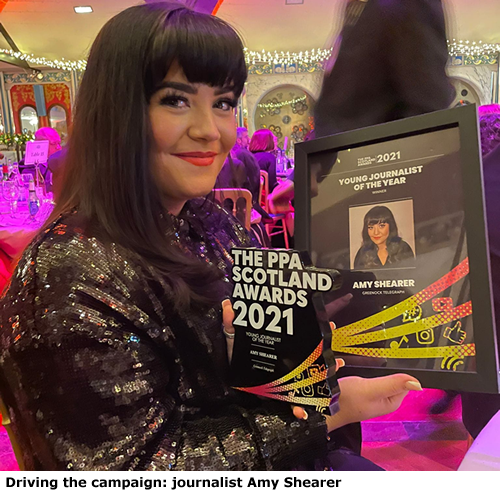
Last year the Telegraph led its Newsquest sister titles in enforcing a social media ban on bad news for 24 hours to promote its campaign. As part of this year’s initiative, the daily shared good news stories and advice on where to turn for help for those struggling with their mental health. Spearheading the campaign is its digital audience and content editor, Amy Shearer, who told Scottish Review: ‘We wanted to be a catalyst for change. All too often the media are portrayed as being of detriment to mental health â not in support of normalising conversations surrounding it.
‘As well as sharing positive stories about local people doing well and overcoming struggle to find hope, the campaign has been endorsed by some amazing celebrities such as Still Game star Jane McCarry and entertainer and Britain’s Got Talent star, Edward Reid, who join a whole host of individuals who are sending video messages of support and encouragement across our platforms.’
Last year, Amy, 23, triumphed in the Young Journalist of the Year category in the Professional Publishers Association (PPA) Scotland annual awards, which recognise and celebrate achievement across the Scottish publishing and media industry.
Lauding Amy’s success, PPA Scotland said: ‘The judges thought our winning writer showed clear promise with the evidence appearing in their testimonial. A willingness to push themselves has made them the standout winner this year â going beyond the publication and making full use of social media’.
Amy began her career as a trainee multimedia journalist with the Telegraph in 2020 and she was promoted to her current role seven months ago. At the time of winning her award, she told HoldTheFrontPage (HTFP): ‘To begin my career in this field during a global pandemic has not been without its challenges, but it has been incredibly rewarding and humbling to share the stories of the brilliant people of Inverclyde. I work with a fantastic team and I am privileged to be trusted by so many local people with things that matter most to them.
‘When I started working as a journalist, people asked me why I was entering a dead industry â but seeing such outstanding talent and incredible journalists be recognised by PPA Scotland for their work has confirmed that I have made the correct choice in entering an industry in which I will hopefully have a long and fulfilling career.’
HTFP commented: ‘Amy’s work on the mental health campaign has shone a light on the support offered on its patch in a bid to inspire others to reach out for assistance. The Telegraph subsequently reported its newsroom was contacted by a string of local mental health and counselling charities, who reported a surge in demand for their services â and volunteers coming forward â thanks to the initiative’.
Amy added: ‘Last year, I shared my own story â I published a first-person reflection on the bullying I experienced as a teenager and the impact it had on me. All too often people remain silent as they don’t want to speak up for fear of judgement. The more we can do to normalise mental health issues, the less taboo the subject will become’.
The Greenock Telegraph’s editor Brian Hossack said: ‘Amy has been an outstanding addition to our team. She always showed great promise and the PPA Scotland award is a testament to her hard work. She truly loves representing Inverclyde and telling the stories from the fantastic communities we have here. She is a credit to the Greenock Telegraph and to the area’.
Incidentally, the Telegraph, which was founded in 1857, was the first halfpenny daily newspaper in Britain.
4.
The Daily Star’s circulation has fallen below 200,000 for the first time in its 43-year history. Press Gazette reports that the tabloid had an average daily readership of 197,998 in December, according to the latest Audit Bureau of Circulations (ABC) figures for national newspapers.
Press Gazette pointed out: ‘The figures show continuing print readership decline as the lowest the Daily Star’s circulation had gone during the first COVID-19 lockdown was 219,275 in April 2020. It follows Reach stablemate Sunday People’s circulation falling below 100,000 in November. In December, the Daily Star Sunday and Sunday People saw the biggest annual circulation drops of 20% and 19% respectively’.
The only paid-for newspaper to grow year-on-year was the Financial Times, which has upped the number of bulk copies given away for free since last year. However, it still fell 2% month-on-month with bulk copies, newsstand sales and subscriptions all down in December.
Based on the ABC figures, the top-selling UK national newspapers in December were the Daily Mail with a sale of 902,111 â down 10% year-on-year, and The Mail on Sunday which sold 787,761 copies â down 9% year-on-year.
I have received the ABC circulation figures in December for only three Scottish titles. And they don’t make for especially good reading. The Sunday Mail, at 73,048, was down 17% year-on-year; The Sunday Post, at 56,195, was down 18%; while the Daily Record fell by 14% to 75,871. I’m unable to provide circulation figures for the titles in The Sun, The Times and Daily Telegraph stables. They have all chosen to keep their ABC circulations private since the beginning of 2020. The Guardian and The Observer joined them in September 2021.
Press Gazette said the last ABC figures it had for these titles were: The Sun: 1,210,915 (March 2020); The Sun on Sunday: 1,013,777 (March 2020); The Sunday Times: 647,622 (March 2020); The Times: 365,880 (March 2020); Daily Telegraph: 317,817 (December 2019); Sunday Telegraph: 248,288 (December 2019); The Observer: 136,656 (July 2021) and The Guardian: 105,134 (July 2021).
5.
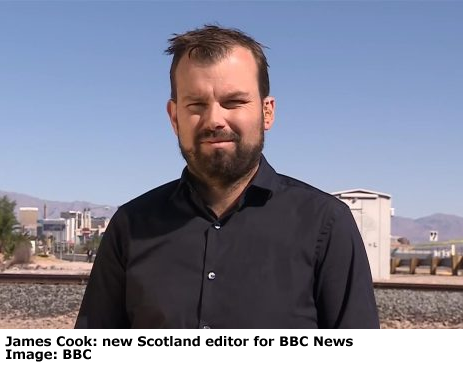
James Cook, who has been chief news correspondent and occasional presenter for The Nine on the fledgling BBC Scotland channel since 2019, is to replace Sarah Smith as Scotland editor for BBC News.
James, 44, who was educated at Forfar Academy, joined BBC Scotland in his 20s. He has presented many news and current affairs programmes including Good Morning Scotland and Reporting Scotland, and covered the lead up to the 2014 Scottish independence referendum for the BBC News channel. He was also based in Los Angeles as a North America correspondent for the BBC for three years.
Richard Burgess, interim senior controller of BBC news content, said: ‘As well as being an excellent journalist, James also cares deeply about Scotland â its history, culture and politics â and has a strong commitment to our core BBC values of impartiality, accuracy and fairness. He has a clear vision for the Scotland editor role, knows what works on digital, and crucially, what matters in modern Scotland’.
Cook takes over from Sarah Smith who has been appointed as the BBC’s North America editor. She was on a salary of £185,000 in her Scotland editor role, according to Scottish news website Daily Business. Cook’s salary has not been disclosed.
6.
BBC Radio Scotland is serving up a special dish for rugby fans with a new breakfast show during the run of the Six Nations. Presented by Laura McGhie and Andy Burke, along with contributions from Tom English, the team set the scene from 10am until midday every Saturday morning during the tournament.
The Rugby Breakfast Show was launched in advance of the Scotland v England match on 5 February, which Scotland narrowly won 20-17. The concept follows on from the success of last year’s Euros Breakfast Show and is available on 810 MW and on the BBC Scotland Sport website.
The programme comes from the grassroots of the game and takes in live audiences in the social clubs of local rugby teams in Edinburgh, Cardiff and Dublin. It features a different comedian each week and one of Scotland’s most popular comics and former rugby player, Susie McCabe, joined the team for the launch show. There is also live music.
Tom English has been secured on a loan deal from the station’s Football Breakfast Show and presents his ‘Shot at Glory’ â a 90-second spot that pits guests against each other in a test of their rugby knowledge. Guests lined up include John Barclay, Brian Moore, Peter Wright, Dan Lydiate, Johnny Beattie and Ryan Wilson.
7.
The Scottish Press Awards 2022 is now open for entries. There are 33 prizes at stake with the categories covering national, regional and online publications. Journalists and titles wishing to enter need to meet a 3 March deadline. The shortlists will be announced prior to the awards ceremony at the DoubleTree by Hilton Glasgow Central on Wednesday 21 September.
The awards organiser, the Scottish Newspaper Society’s director, John McLellan, told me: ‘Scottish news publishers continue to innovate and digital audiences for high-quality journalism are being sustained despite enormous pressure throughout what has been another extraordinarily difficult year. Quality, independent Scottish journalism is as vital as ever in bringing the industry together. Last year’s event was a great success, and we are once again looking forward to gathering and celebrating all that’s good about Scottish journalism. There is a lot to celebrate, support and defend’.
More information can be found here.
8.
Last week, we reported that Channel 4 is ‘publicly-funded’. My apologies. This was incorrect. Channel 4 is one of the UK’s public service broadcasters. It is a publicly-owned, non-profit organisation that invests its income back into commissioning content. It receives no public money and is funded entirely through its commercial activity. Most of its income comes from TV and online advertising.
There are persistent rumours that Channel 4 could shortly be lined up for privatisation. According to a report in the Financial Times, the options would include an outright sale; a partial offloading of the UK Government’s stake; or a mutual ownership model.
9.
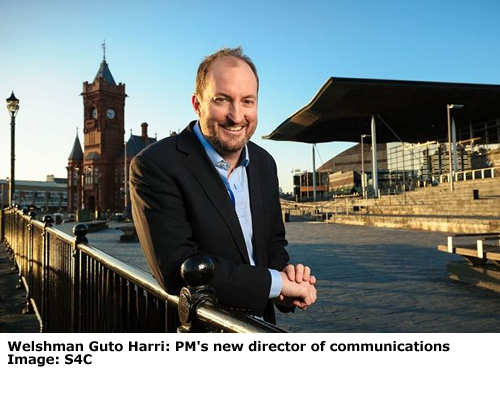
There is a certain element of surprise in Boris Johnson’s decision to appoint Guto Harri as his director of communications following the resignation of Jack Doyle. It is not the first time Harri has worked for Johnson â he was his director of external affairs from 2008-2012, when Johnson was Mayor of London.
Harri’s appointment comes after he was suspended last year by GB News for taking the knee live on air during a debate about racism towards England’s black footballers. The channel apologised and said the gesture had breached its editorial standards. Harri resigned in protest and declared that GB News was ‘rapidly becoming an absurd parody of what it proclaimed to be’.
The Mail on Sunday this week reported that in 2018 Harri claimed that Johnson was ‘digging his political grave’ after a series of ill-judged remarks in a newspaper column, and said he would be ‘hugely divisive’ as Prime Minister. The report added: ‘He [Harri] unleashed a torrent of scathing criticism about his former boss when interviewed by the BBC, suggesting that Mr Johnson had gone from being seen as a unifying politician attractive to voters across the political divide, to a far more politically tribal figure’.
Cardiff-born Harri, 56, an Oxford graduate, who also completed the graduate journalism course at Cardiff University, worked for the BBC for 18 years on television and radio, and was its chief political correspondent from 2002-2004. He has also held a number of PR jobs for private companies in recent years.
Jack Doyle, a former Daily Mail political reporter, was Johnson’s press secretary in 2020 and promoted to director of communications 10 months ago. He was on a salary of between £140,000 and £144,999.
Meanwhile, former Daily Telegraph editor Will Lewis has reportedly joined a ‘brains trust’ of new advisers to Boris Johnson. Lewis, who is also a former chief executive officer of Dow Jones and Company, and publisher of The Wall Street Journal, last year launched The News Movement in the UK â designed to fight disinformation and deliver trustworthy information to mass audiences on social media, along with former BBC News editorial director Kamal Ahmed as editor-in-chief. A source told The Sunday Times: ‘Will has been providing advice but will not be taking a formal role’.
10.
Broadcaster Andrew Neil is said to be close to signing a deal with Channel 4 to front a weekly political analysis show. Daily Business reports: ‘The former Sunday Times and BBC journalist is in discussions with director of programmes Ian Katz and director of news and current affairs Louisa Compton following his fall-out with GB News, according to trade publication Broadcast. Talks with Channel 4 are said to be focused on a Sunday evening slot for the show, possibly to follow the 6.30pm news bulletin, currently watched by 600,000 viewers. Sunday mornings have been ruled out to avoid a clash with political programmes on the BBC and Sky. Scheduling a programme for Sunday evening, however, would enable Neil to further analyse whatever emerges from these shows’.
Neil’s spell at GB News, where he was also chairman, proved an unhappy experience. The audience for his nightly news programme quickly peaked at 300,000 – outperforming the BBC and Sky. However, the station was apparently plagued with production errors and disputes that led to his departure after just three months.
11.
TalkTV, Rupert Murdoch’s latest entry to the UK media scene, is expected to launch any day soon. The new channel has recruited Tom Newton Dunn, Times Radio’s chief political commentator and the former political editor of The Sun, to host a nightly 60-minute prime time news programme on Mondays to Fridays. And Sky News political correspondent, Kate McCann, has been hired as political editor. Before joining Sky in 2018, Kate was senior political correspondent of the Daily Telegraph and political correspondent of The Sun.
Industry sources report that the new channel is planning to air a satirical news programme along the lines of the BBC’s Have I Got News For You and is currently recruiting staff for it.
TalkTV, part of the UK News stable, has already hired Piers Morgan as a presenter on a reputed £50m contract over three years, and several of his former colleagues at ITV’s Good Morning Britain programme. It will feature hourly news bulletins, sports and entertainment shows, as well as current affairs, debate, opinion and documentaries. It will use people and programming from across the News UK stable including The Sun, The Times, The Sunday Times, Times Radio, Talkradio, Talksport and Virgin Radio.
News UK chief executive Rebekah Brooks said: ‘We are committed to providing choice for television and streaming viewers and bringing the best of our journalism to the screen. Taking advantage of modern technology, we can produce high-quality shows at low cost’.
12.
BT is in talks with Discovery on a deal to create a new sport and entertainment package for UK customers. It would be a 50/50 joint venture bringing together BT Sport with Eurosport UK.
The new combined business would remain committed to retaining BT Sport’s existing major sports broadcast rights while BT Sport customers would get access to Discovery’s sport and entertainment content. It would hold rights including the Premier League, Champions League, Olympics, and tennis grand slams.
BT aims to conclude discussions with Discovery soon to enable the new company to be operational later this year â subject to completion of the deal and approval by the relevant competition authorities.